Week 6 has benefitted from both a 1:1 session with my tutor and portfolio review with the exceptionally talented Jack Latham. This was a fantastic opportunity to discuss ideas for a new direction for my practice, building on the images I have created to date.
Much of my current practice has involved research and writing, looking at the human condition, what makes us tick, why do we make the choices we make and, more importantly are those choices imposed upon us. I am most interested in where we live, and by ‘we’ I talk about the classless, the people who fall between the cracks between absolute poverty and a comfortable living. Typically, this suburban landscape is home to teachers, nurses, supervisors, and middle managers; falling through the cracks to become a silent majority.
However, the built environs of suburban landscape hold a key to our national identity and as such social housing, blocks of flats and housing estates have become our woodland, hills, and mountains, meanwhile the allotment become the oasis in the concrete desert. Renting has created the modern nomad, moving from one house to another in search of affordable accommodation.
Inside out: Home and Landscape
I have been creating topographical/architectural images of the suburban landscape in a three miles radius of my home. Images of vernacular housing, in sharp contrast to Bath’s stereotype of a grand Georgian city and tourist destination. However, my images are not just about the built environment but the people how make a home of this landscape. For me to tell the stories of the people it is important that I employ a method of documentary that does not employ working class tropes to belittle their socioeconomical status. I am proposing to construct a series of images that create a tangible link between the internal landscape of the ‘Home’ and the external suburban landscape. Using the self-portrayed figure as a simulacra of the home owner, I intend to represent the story of the inside, of the home.
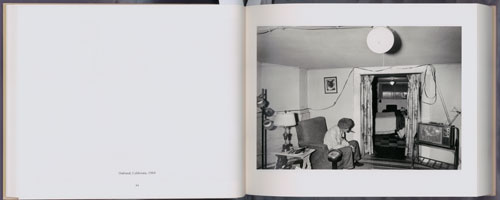
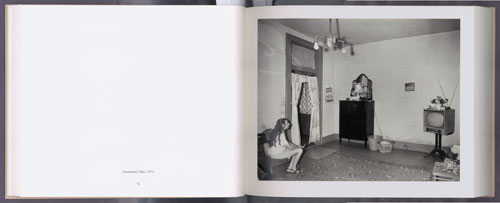
Figures Chauncey Hare 1960/701 & 2 Interior shots of home life
Protest Photographs by Chauncey Hare is a culmination of two decades of images production, the interiors of working-class homes and workplaces across America in the late 1960s and early 1970s. Hare worked as a factory employee for Standard Oil where he came into contact with many of his subjects. It is Hare’s images of the home place that strike true with me, these honest representations of working-class homes, often featuring the occupants relaxing in front of the TV after a day’s work. [Fig 1&2]
“Hare recounts how, over his years of production, he felt obliged to “Honour the reality of each person and their home” and speaks of a need to relate “the truth of people’s lives”. Yet this is not a measured, dispassionate process.” [Grant 2010:Online]
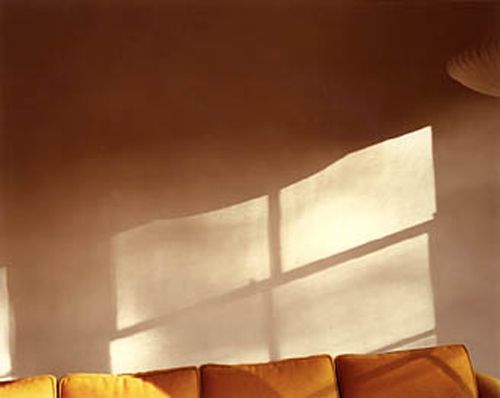
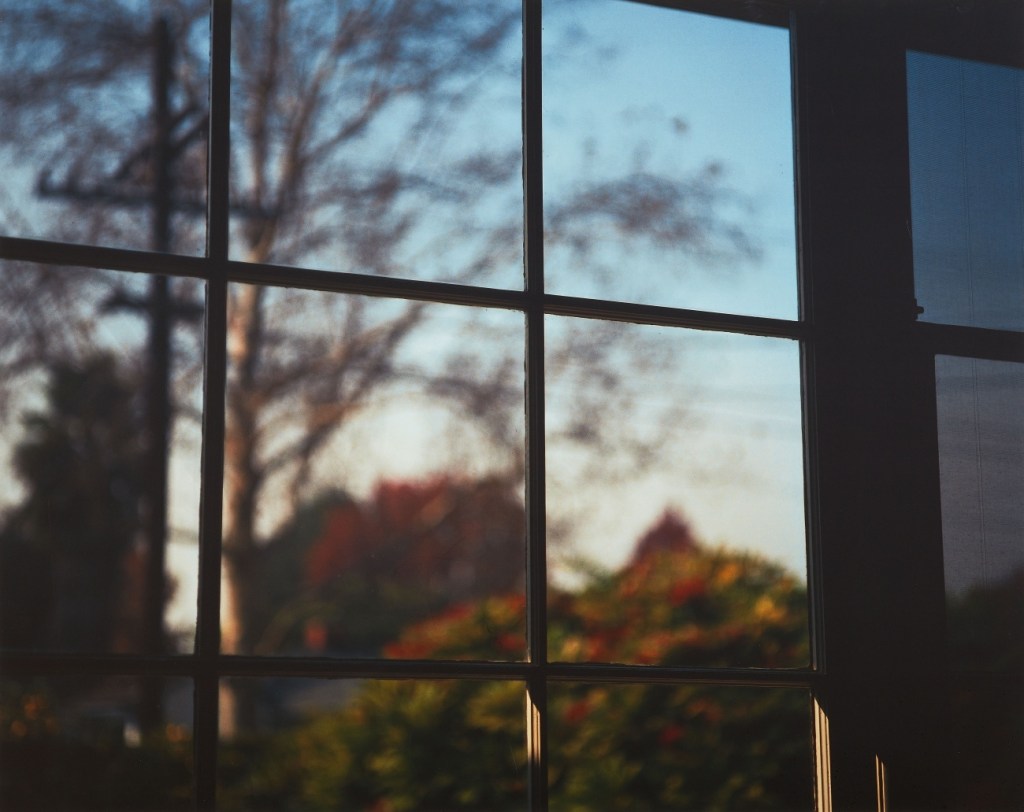
Figures 3 & 4 Uta Barth images from Nowhere near 1999
The context of looking out from the inside is one that Uta Barth explores in a less traditional way, in particular the series ‘Nowhere near’ presenting the space between objects, the seen and unseen. The use of window frames to focus the beholder, enticing to look outside beyond the frame. [Figs 3&4]
“Barth’s photographs, when installed in galleries, resonate phenomenologically. The space between the viewer and photographs become part of the interplay between space and subject, seeing and not seeing.” [Cotton 2009:133]
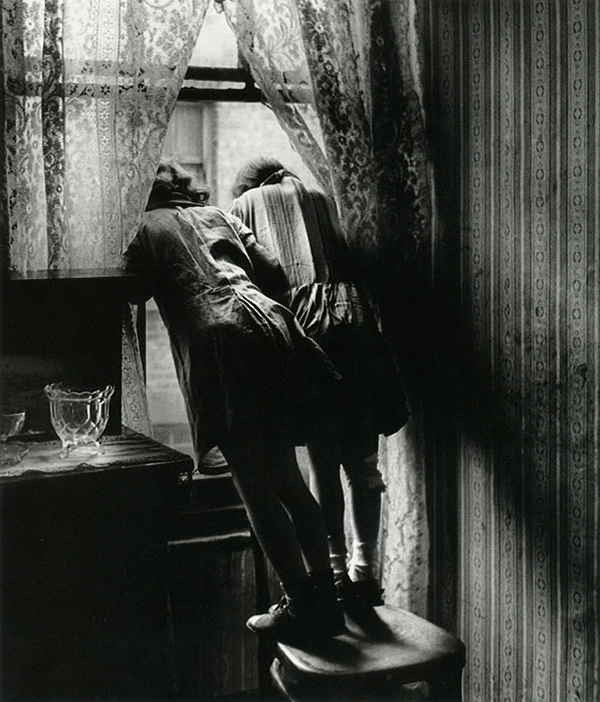
Figure 5 Bill Brandt, 1955 London Child
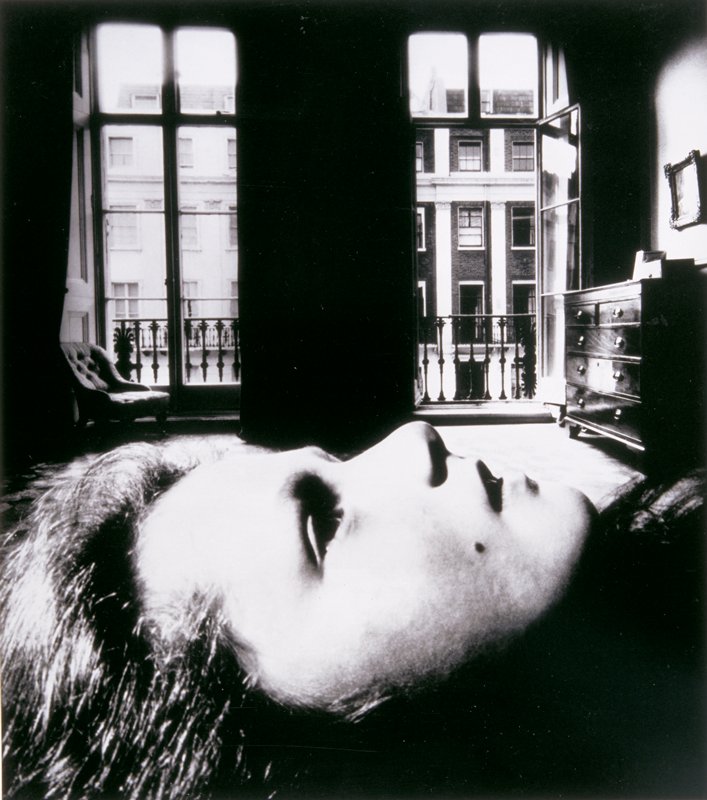
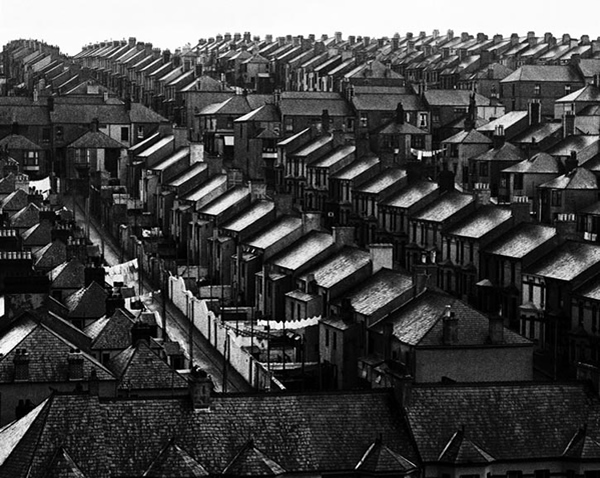
Bill Brandt is another photographer I have begun to look towards for inspiration in particular his imagery of industrial cityscapes and home interiors. [Figs 5&6] When looking through Brandt’s canon of work, I have started to pair images to obtain then type of images I want to achieve. Isolating the core concepts of interplay between the interior and landscape.
Figures 6&7 Bill Brandt images of working-class 1950s
References
Cotton. C (2009), the photograph as contemporary art, Thames & Hudson.
Much of my practice has been subjective and engaged the use of constructed or staged image making, either through directed figures, often myself as performed self-portraits (fig 1) or via digital manipulation as photomontages (fig 2). Much of the work produced during the last module was influenced by the repeated use of the ‘Ophelia’ icon within the photographs of Tom Hunter and Gregory Crewdson. I wrote about this in more detail in my CRJ: https://thespacebetween.photo.blog/2020/10/09/the-photographic-tableau/
“Hunter makes the art-historical connection quite explicit to anybody with some knowledge of European art.” [Smith & Lefley 2015:127]
Figure 1. Tim Beale 2020 ‘Ophelia’
Figure 2. Tim Beale 2020 ‘Untitled’
However, the images I have recently taken take on a more objective approach, as straight photographs of that thing at that time. The choice to create straight object images was a result of the 3rd national lock down and my unease of taking out my full photographic kit. I feel that much of these objective images are more for research in location for later images. As such I have begun to log my walking routes, limiting myself to no more than a 2 hour walk and often in a loop.
“There is a lot to dig deeper in with Twerton/shops – what is it that makes a shop stand out – why is McColls different to Aldi, different to Morrisons, different to Waitrose, what is it that stands out when you visit those shops? The story might emerge from the direct experience rather than the photographic.” [Pantall.C False Indexes Forum: FF]
I’m now at the stage of thinking and research, trying to build up a narrative for these latest images. Over the next few weeks, I plan on revisiting a particular area of Bath, Twerton as I feel I have a strange affinity for the area. This probably because it reminds me of where I grew up but as it is one of Bath’s most deprived areas, I feel there it is underrepresented. There’s a story to be told, I just need to find it.
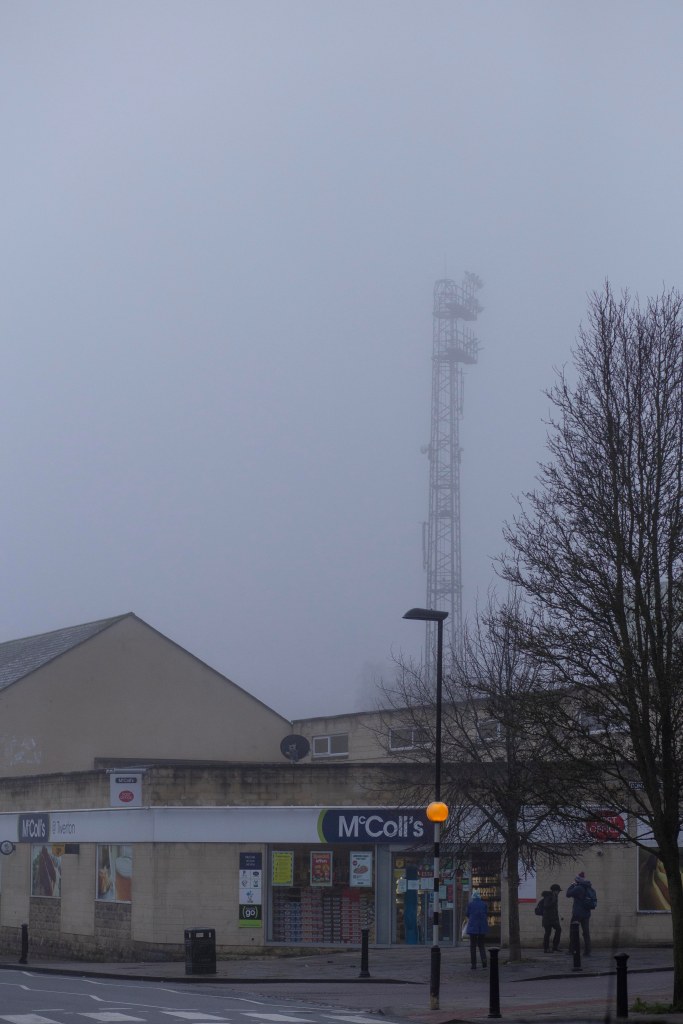
The fog in figure 3 has added a unique quality that I could not recreate artificially, as a result I feel this image takes on an ethereal quality. The lighting tower, dominates the small shop, looking no unlike a prison watch tower or prehistoric predator. We see shoppers, in the lower section of the image, huddled waiting their turn to shop for the essentials.
Figure 3. Tim Beale 2021 ‘Untitled’
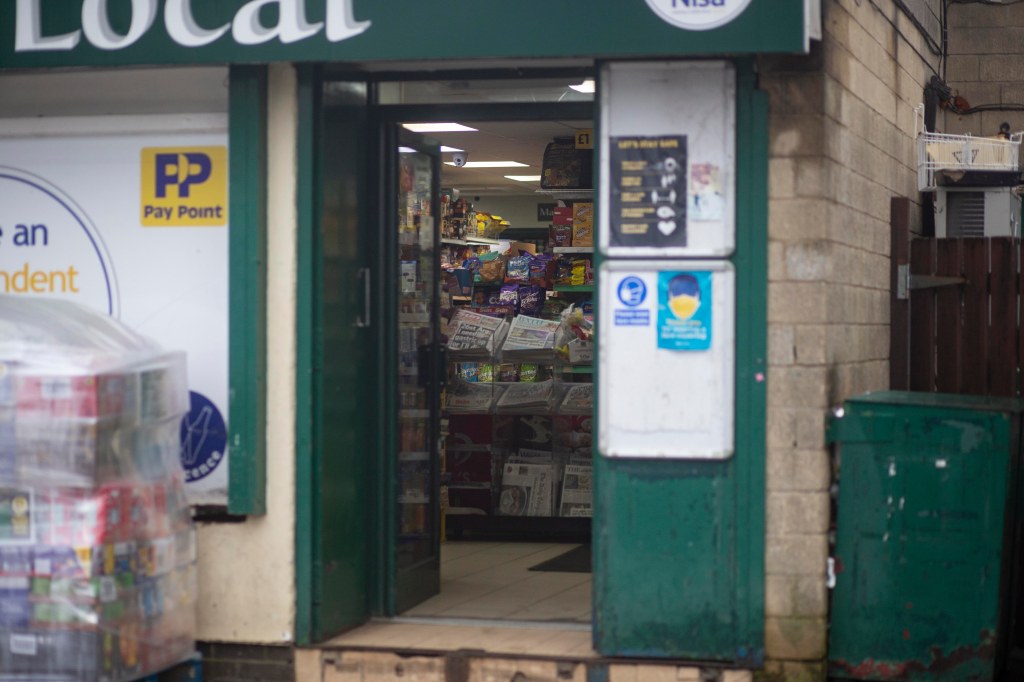
I took this shot of the newsagents with a view to capturing something of the essence of a typical UK “local” shop (Fig 4). The headlines from each newspaper came be seen and read through the open door. I’m not entirely happy with this one and plan to revisit at night as I feel the dynamics of lighting will change the feel greatly.
Figure 4. Tim Beale 2021 ‘untitled’
Figure 5. Kelli Connell 2010 ‘Next Door’
Figure 6. Kelli Connell images from ‘Double life’
As we look to a more eased lock down, I can start to schedule in more involved photo shoots, look to use self-portraiture again. Kelli Connell’s series “Double Life” (Fig 5) is a fascinating use of the constructed image to depict the made-up story of a couple’s everyday life. The photographs have a voyeuristic quality to them, as if we the view are witnessing these live events unfold, through the eyes of the photographer. What has drawn me to these images is the fact that, what we are looking at is not images of two women, but self-portraits of Connell playing both roles in this relationship (Fig 6). Connell’s performance is such a powerful one that we are convinced of the ‘real’ emotions of this relationship. The viewer starts question the fact of the image before them as they realise the women look identical and the image takes on a more surreal quality.
When discussing the constructed images of the surrealists Smith & Lefley write: “They were captivated by the strange ambiguity of photographs that are both ‘fact’ and image at the same time.” [Smith & Lefley 2015:120]
When being interviewed for Blowphoto.com Connell talks about the autobiographical approach to these images:
“I think it’s kind of a mirror reflecting what I think about relationships and what I think of my own self as it evolves the older I get. the earlier images show something you might do in your late twenties, like drinking in a bar or playing pool depicting a really young stage in a relationship and now that I’m older many of the things I’m interested in have naturally evolved so the characters might be drinking wine, renovating a house or going to bed early. or an embrace might be the kind of hug that is more fragile from just being through a more long-term relationship; the kind of embrace that isn’t even possible with someone you have just been with a couple of weeks.” [Connell no date published:Blowphoto.com]
I can see there is some scope to adopt a similar process of further constructing images, going beyond the directed and staged approach. Certainly, over the next couple of weeks I intend to revisit archival images alongside recent photographs with a view to experimenting digitally constructing images to represent my research.
References
Smith, P, & Lefley, C 2015, “Rethinking Photography : Histories, Theories and Education”, Taylor & Francis Group, London. Available from: ProQuest Ebook Central. [7 February 2021]. Created from falmouth-ebooks on 2021-02-07 01:41:12.
Pantall.C, 2021 Tutor feedback from “False Indexes” week 3 forum. Falmouth Flexible MA Photography [Accessed 11.2.2021]
Mac Gowan.A “Kelli Connell interview” Blowphoto.com [Accessed 15.02.2021] http://blowphoto.com/issue-13-press-check/
When considering the various characteristics within photography and in particular my own practice. It becomes clear that I adopt a few distinct characteristics when approaching an idea or out shooting and these characteristics drive my own human choices.
The Frame
When considering the idea of an image I will first consider what will fill the frame, not unlike a blank page ready to be written upon. Then I consider what will be outside the frame, what will the view not see, what will they fill in by using their imagination. These two factors are key before even picking up the camera as often this will have a direct bearing on the location of a shoot.
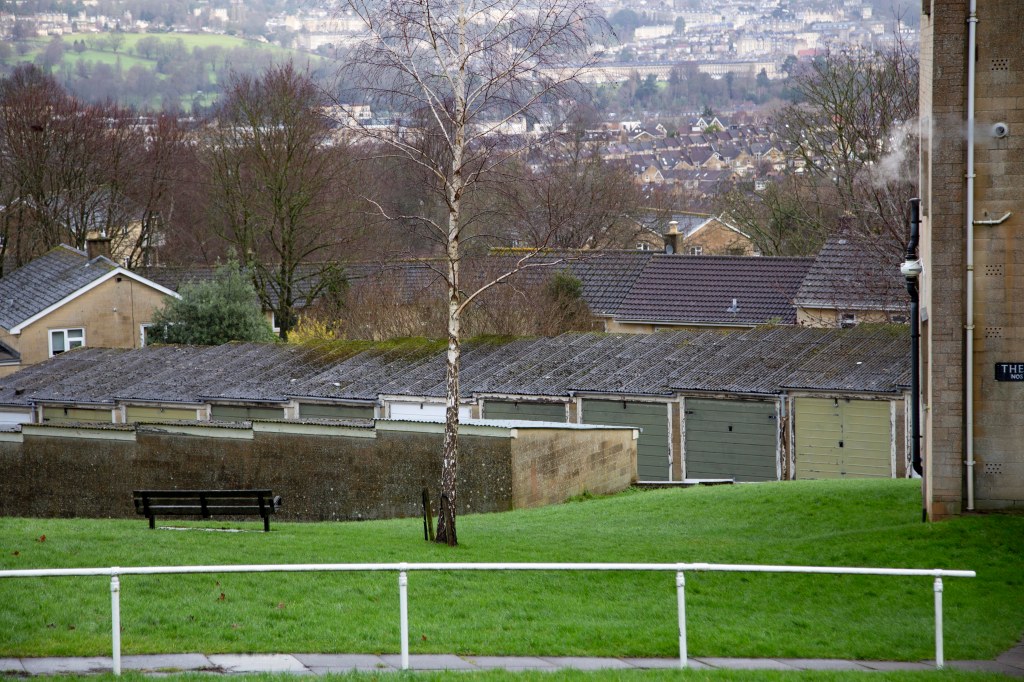
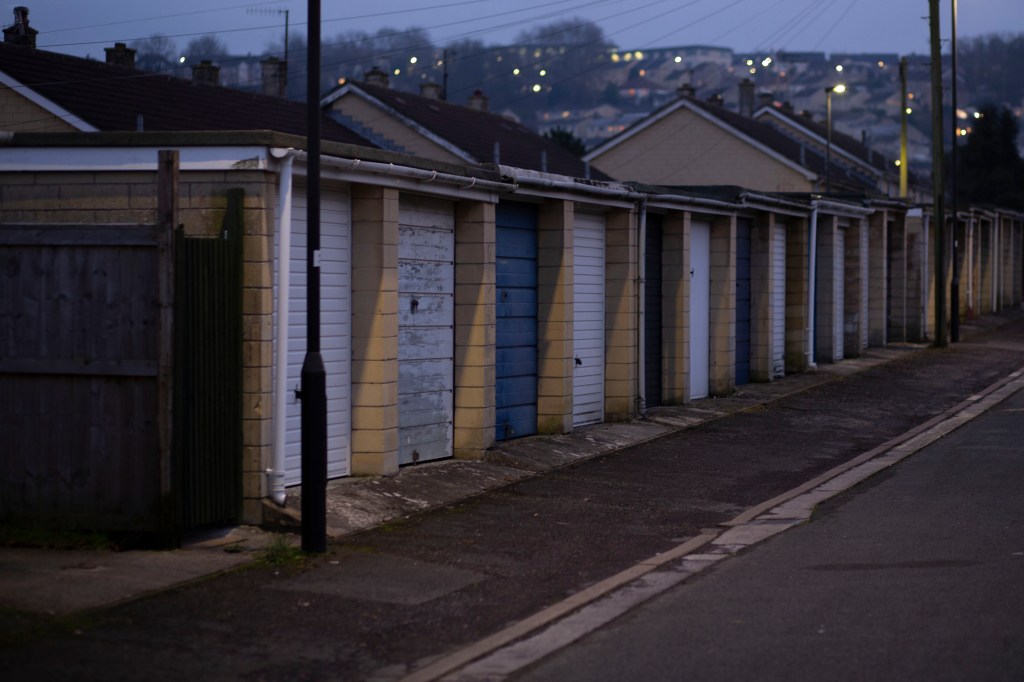
Framing a shot is then a process of working with the environment and the subject. For example, in this image of vernacular garages, the key was to work with the background to juxtapose the garages against the view of the Royal Crescent and Bath countryside. As such we see the use of vantage point to achieve this result.
Fig.1 Tim Beale 2021, ‘Untitled’ Garages & the Royal Crescent, Bath.
“The central act of photography, the act of choose and eliminating, forces a concentration on the picture edge- the line that separates in from out-and on the shapes that are created by it” [Szarkowski 1966:9]
“The Frame ‘isolates’unexpected juxtapositions, creates relationships between ‘facts’ that have been framed, cuts through familiar forms revealing unusual fragments”. [Szarkowski 1966:70]
Focus
I tend to spend time walking without a camera, a kind of psychogeographic exercise in mentally mapping a woodland, city or suburb. Often noting the areas that will work best during particular lighting, time of year, time of day/night or weather.
Fig 2. Tim Beale 2021, ‘Untitled’.
By focus I refer to both the focus of attention (the subject) and focus in a more mechanical sense. Once a shot is in the frame and at the right vantage point, my next consideration is the focus. How to best achieve the impact I desire, what will the viewer need to see and how will they see it, are all questions I have in mind whilst working. There are the obvious traditional methods of setting up a shot using the rile of thirds, depth of field and point of focus. But often it is when choosing to go against this tradition you can unsettle the view, who is conditioned to see in this way. Something akin (for westerners) righting right to left, the reader will still be able to read the text but will have to retrain their brain to do so.
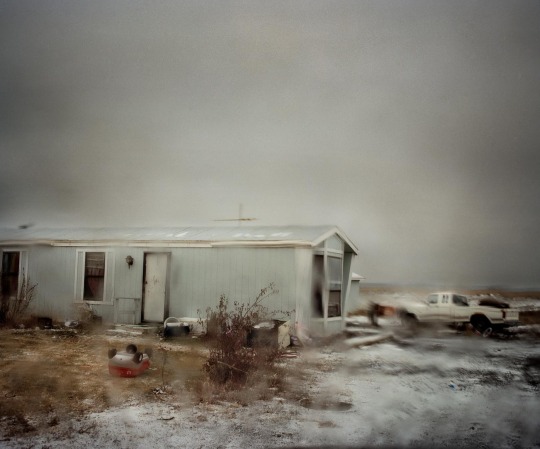
As with Todd Hido’s images shot through ‘rain’ covered car windows, the focus is ephemeral, on the idea of the thing rather than the thing itself.
“Most importantly, I really love dramatic weather. I enjoy outings in those conditions. I feel so good when I’m driving, poking around for pictures, and it’s raining or snowing outside…. Diffused light is has always been the kind of light I’m after. I’m also drawn to backlit scenes, and I often like to shoot straight into the light. Shooting through a foggy dirty, or wet windshield really helps cut the brightness. It also makes for a painterly image.” [Hido 2004:online]
“it’s not just a photograph of the landscape but it is a photograph from my personal perspective. I’m somehow in the picture in a way. That is my breath fogging up the window! It has more of an intimacy I think. It has a subjective, diaristic quality and now that I really think about it—it’s the opposite of something like an ‘authorless’ objective view, which is most often seen from a higher, uncommon viewpoint.” [Hido 2012:online]
“Hido keeps at least three water bottles with him in his car. One time, I watch him spray his windshield before taking a landscape photograph. ‘I’ve learned from sheer disappointment that sometimes I need to take pictures, but it isn’t raining outside,’ he says.
Fig 3. Todd Hido 2010 #9197. From the ‘Roaming’ photo book
Sometimes the artist sprays glycerin on the windshield, for a different kind of effect. It’s a technique he compares to changing paintbrushes. The size, direction and position of drops of water on the car window inform the photograph that results, and within these fictitious raindrops, Hido says he can ‘compose’ the real picture that he wants to see. Ultimately, each photograph is a composition. It is a way of giving shape to a mental state, as opposed to capturing an actual setting.” [Tylevich.K undated:online]
The use of focus/unfocus within an image as in Fig.2 are like our memories, sometimes hazy or unclear and other times pin sharp and crystal clear. This is something that Hido manages to capture with his ‘Roaming’ images, landscapes both in and out off focus.
One of the final considerations is the end result, who the audience is and how the final images will be viewed. This to me have been something of a new choice, having only exhibited in joint exhibitions and one small solo exhibition, my experience is limited. However, in my current practice I have begun to these make choices. If we look to fig 1 again, for the viewer to understand the image they need to see the juxtaposition between the mid ground (garages) and background (landscape) as such the final print will need to be large, perhaps 160x100cm or larger. As my practice and personal project develop so too will the choices I make.
“The space between” is a project born out of my exploration of how the natural and built environment has helped to shape the person I am. This project was born out of my fascination of the emotional bonds we have with our environment, how those bonds and links strengthen during the course of our lives. Often when we recall a memory of a key life event we will associate that memory with place, the house we grew up in, the school we went to, church we married or graveyard are parents are buried.
“Biophilia is idea that humans possess an innate tendency to seek connections with nature and other forms of life.” (Rogers 2019).
Within my images I set out on a personal journey to explore the places of nature that I have a subconscious bond. From an early age I would often spend much of my time escaping to nature, even skipping school so that I could go for long walks in the woods and planning imaginary journeys to Sherwood Forest. Jeff Wall’s tableau photography has been a source of inspiration for my practice so I looked to adopt a similar style to my own work for this project.
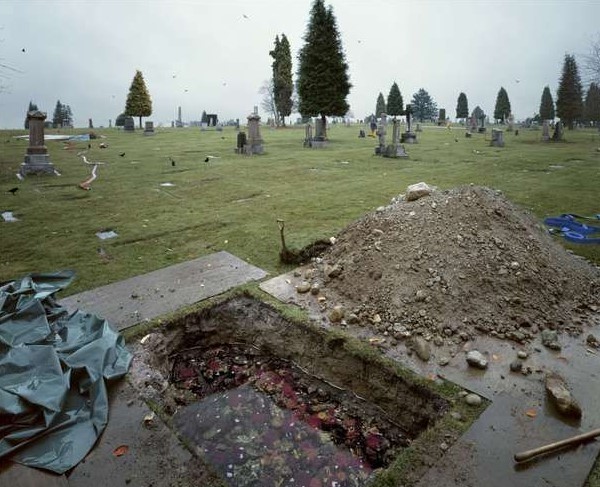
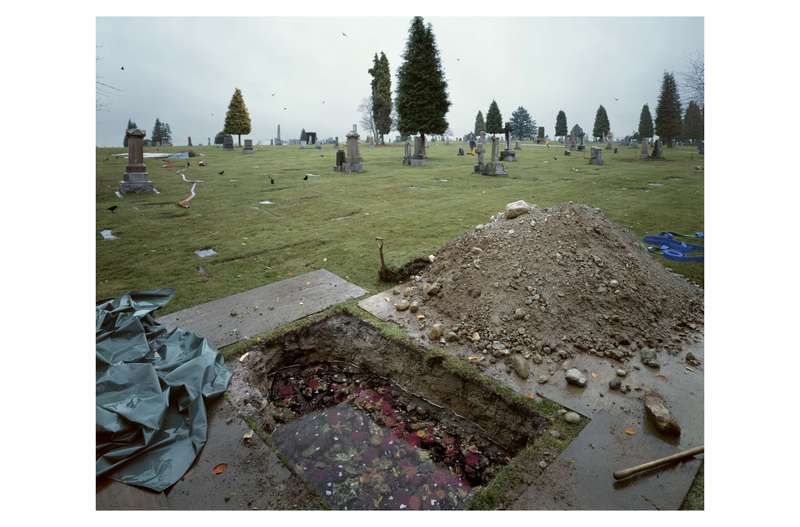
As one of the most prolific users of the tableau is Jeff Wall who’s images are created from scenes he has witnessed or memories, these he meticulously recreates. Wall’s exhibition ‘Tableau Pictures Photographs’ 1996-2013 we see images such as ‘Flooded Grave’ in which an open grave has been filled with water and sea life, such as star fish and sea urchins. This is typical of the way in which Wall plays with the tension between the real and the unreal. For Wall it is the way in which we fill voids with our daydreams, in our daydreams we see what isn’t there (Poel & Schweiger 2014). When exhibiting his work, Wall uses large light boxes to display his colour images, giving them a luminosity that adds a hyper real quality to them which is turn confronts the viewer with the drama in front of them. The images become more than a photo and more akin to a lit stage. Wall a post graduate in art history has a deep understanding of how space is full of relationships and how to construct a visual scene for the viewer.
“they [Wall’s images] are evidence of a detailed comprehension of how pictures should work and are constructed.” (Cotton 2004:51)
Fig 1. Flooded Grave, Jeff Wall 1998-200
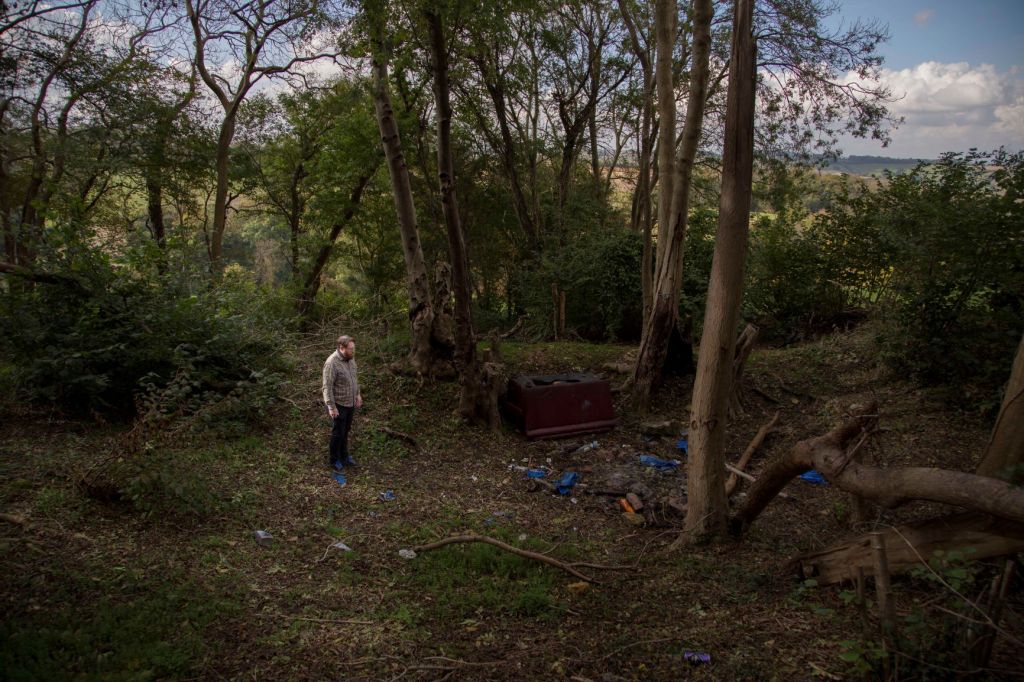
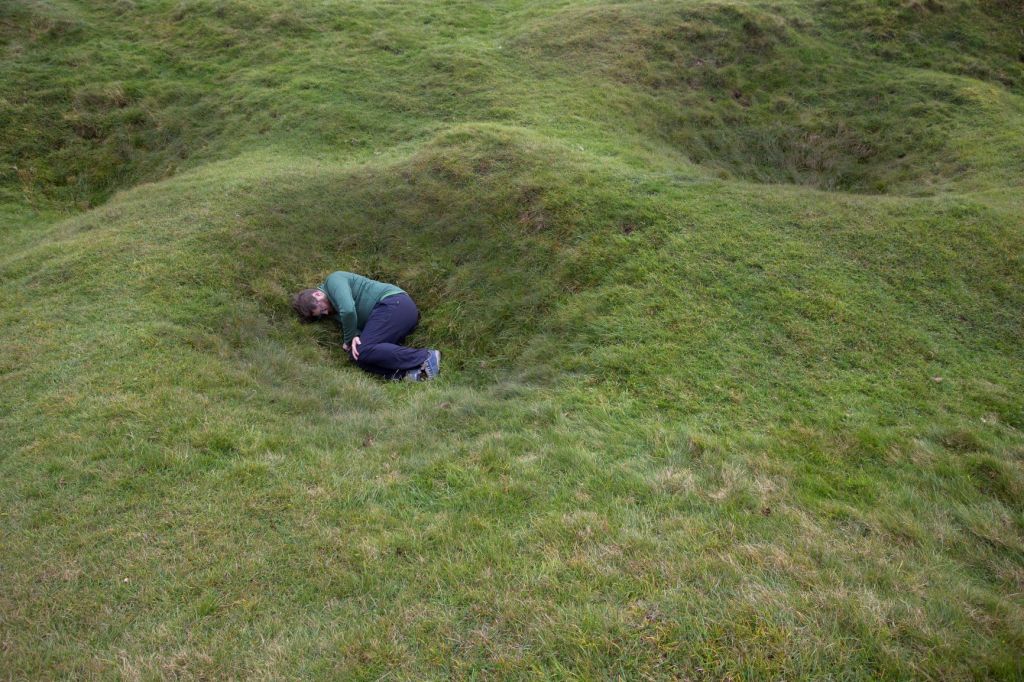
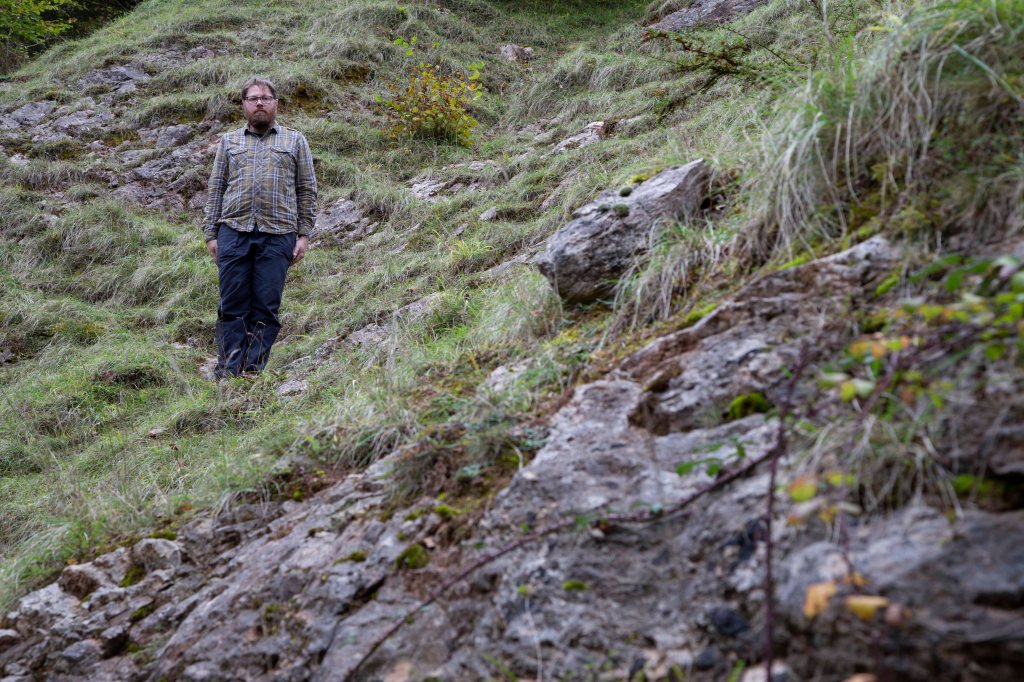
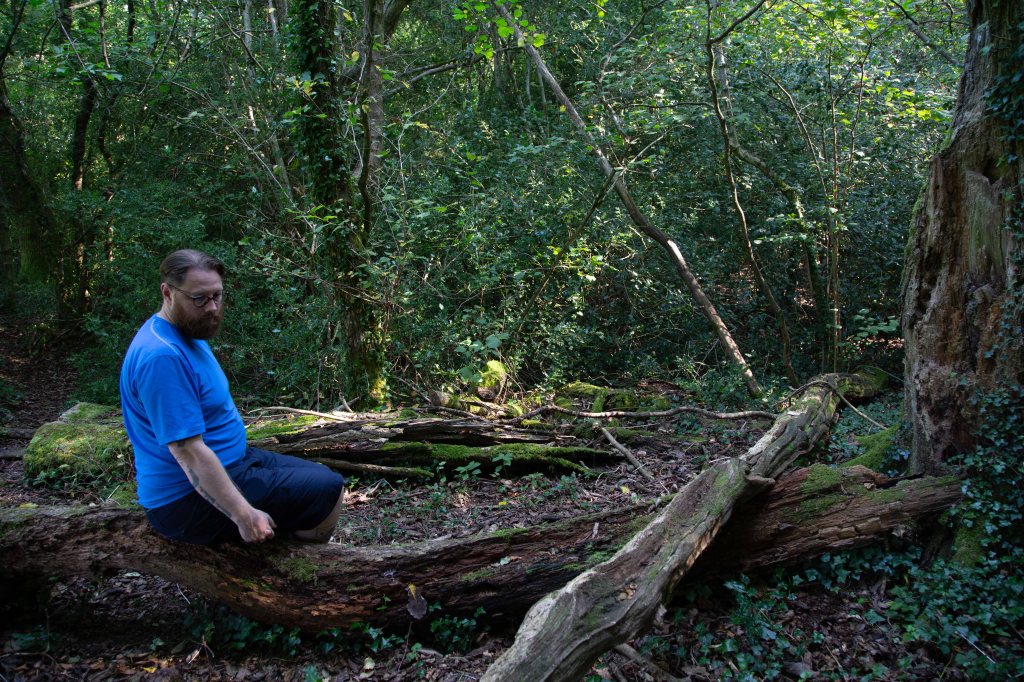
In my own imagery I have attempted to engage the view, giving them a glimpse of a story, just enough to leave them to create their own story. The choice of clothing colour was made prior to the shoot so as to achieve two factors, 1) not to overly blend in with nature and 2) not to stand out so as to distract the viewer’s gaze. The following images were used in my last WIP portfolio as I felt the to be reflect what I’d set out to achieve.
Fig 2. I come from a broken home, Tim Beale. 2020
Fig 3. Birth, Tim Beale. 2020
I felt that these images Figures 2 & 3 worked well as they have a stronger feel, the colours work, there is enough to tell a story without over complicating the image. Fig 2 was shot with 18th Century paintings in mind, particularly the work of Gainsborough. Making the undesirable landscape picturesque. Fig 3 uses the contours of the environment to create a womblike image.
Fig 4. Untitled, Tim Beale. 2020
Fig 5. Untitled, Tim Beale. 2020
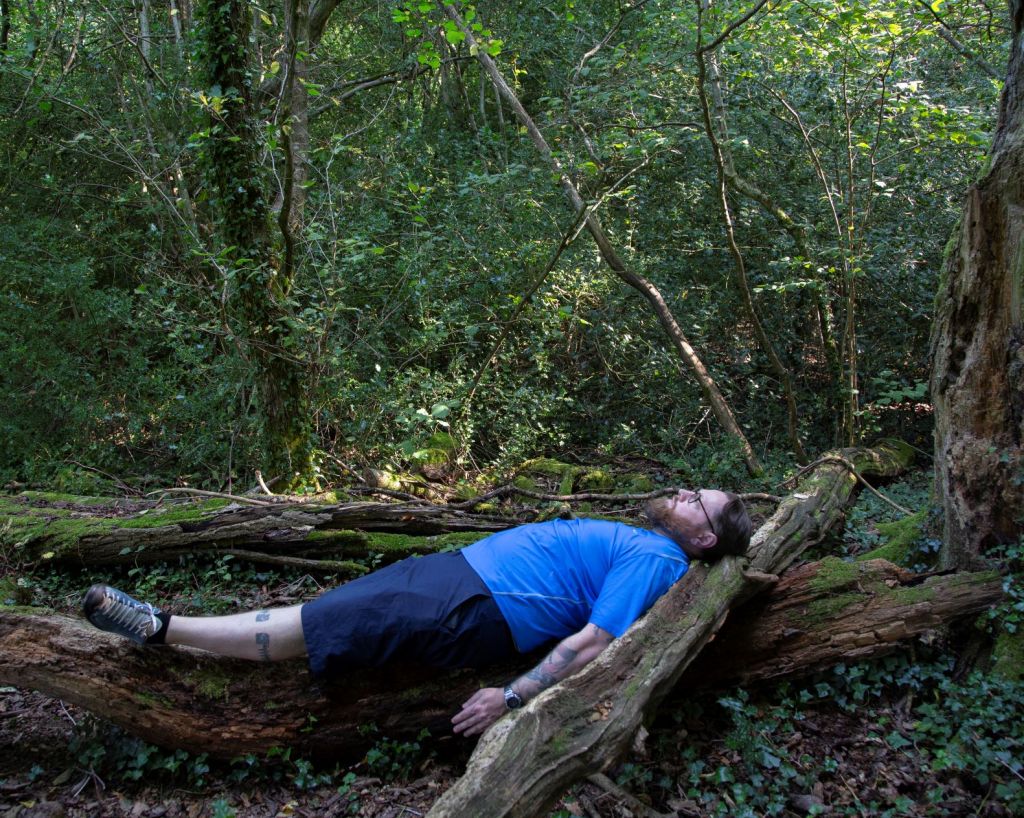
Fig 4 I feel didn’t quite work for me, the angle of looking up feels awkward and the distance from camera not quite right. Fig 5 the lighting was spot on as was the location, however the choice in clothing and colour pallet all wrong.
July 2020, shortly after the initial lockdown ended I took a trip back up to the midlands, Derby, to visit my Dad and step mum. This was also an opportunity to walk the streets, where I once played and visit some of the places that helped shape the person I am today. Then in September my dad died unexpectedly, this sudden loss has had a profound effect on me. My immediate response to the news was to try to escape and loose myself in the woods. I found this time spent, walking and thinking about my dad and my childhood has given me sense of clarity and focus.
I grew up in Derby, an industrial city made up of vernacular terraced housing and Victorian industrial buildings but surrounded by some of the most stunning landscapes in the country. The city was made for work and as such the people who live there are good practical, hard working people. Now some 20 years on after leaving Derby I find myself living in Bath, a city built for pleasure with grand Georgian houses. Two very different cities however each city has a communality (and like most UK towns and cities), the need to maintain something of nature. Walking the streets of our cities you can see nature given a space to flourish, gardens, parks or avenues of trees lining the roads. This notion of suburban nature is something I plan on exploring more during the next few months.
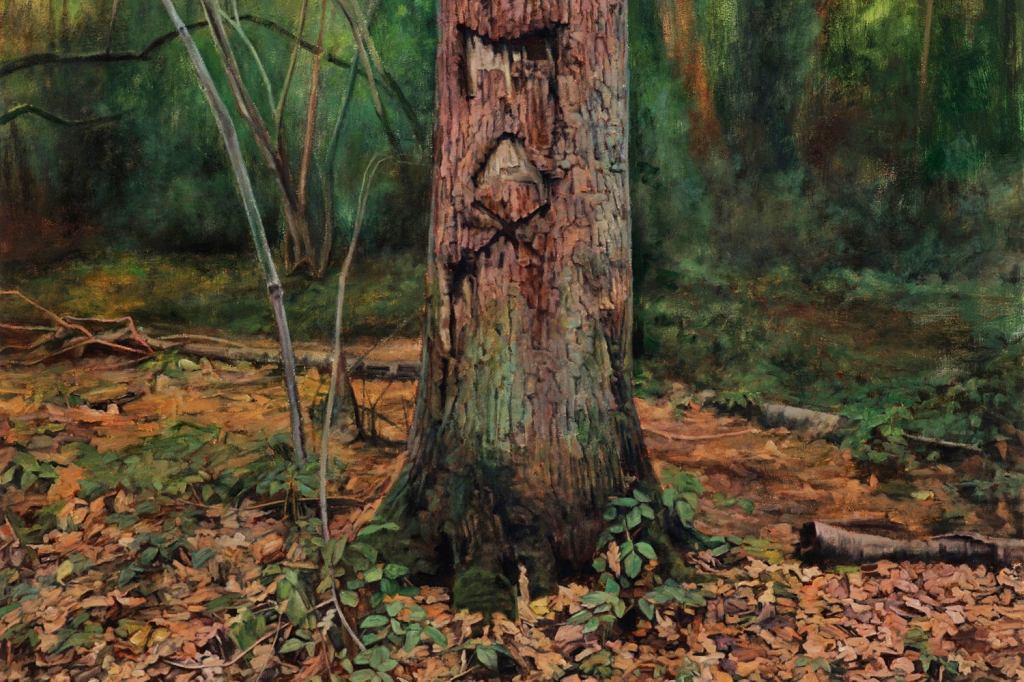
Fig. 6 George Shaw, Scenes from the Passion, 2002
Fig. 7 George Shaw, Scenes from the Passion, 2002
Fig. 8 George Shaw, Scenes from the Passion, 2002
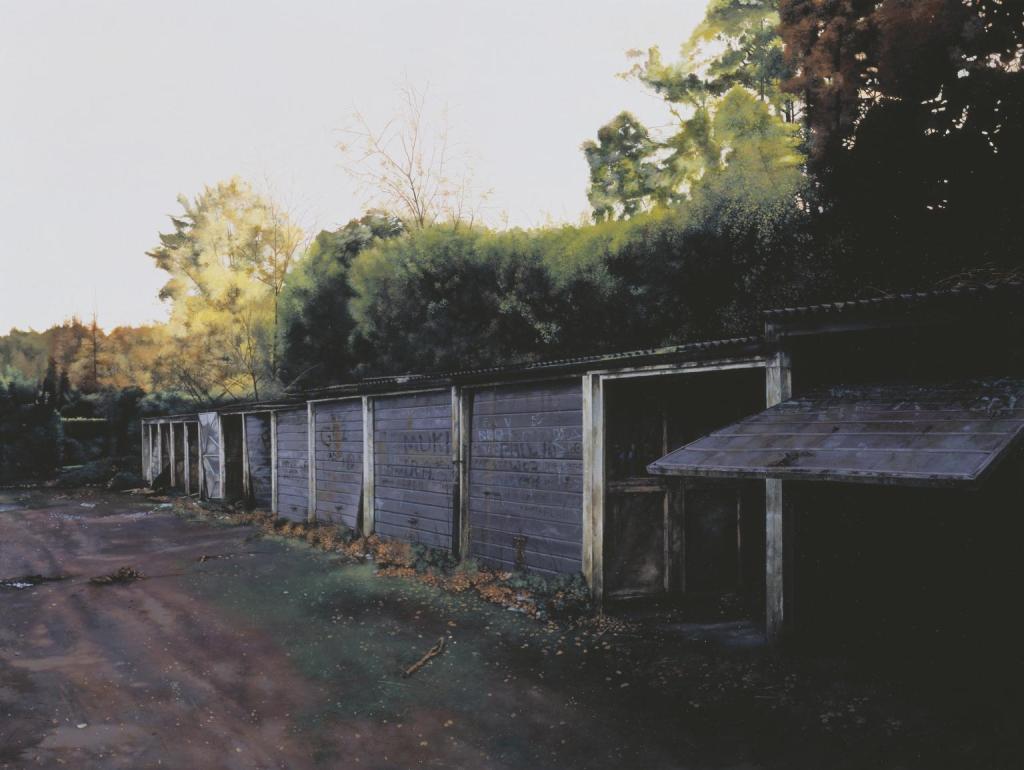
I was recently introduced to the work of a painter who also comes from the midlands George Shawafter sharing a number of my recent photographic works with a friend as he felt their were a number of striking similarities between our practices. Shaw who produces realistic images using humbrol paint on board, a paint I am familiar with from hours spent building airfix models as a kid with my dad. This unconventional medium for painting fits well with Shaw’s unconventional subject matter of council estates in the midlands. Again another similarity with my own upbringing in the midlands.
On first viewing Shaw’s paintings of middle England, I was struck with how the image, which has a photographic quality to it, seemed so familiar. Looking through a batch of recent images of alleyways and side streets I can across my own, unwitting, interpretation. Shaw’s images brought back memories of growing up in the midlands and as such the realisation hit me that this is why I have this odd fascination with alleyways and back streets.
“The drizzly visions of an empty, every man England transcend their bleak settings, inviting viewers to project on to them their own childhood ennui. A rope dangling from a tree, a lock-up garage left open, a broken goalpost: each one suggests possible youthful adventures – or traumas.” Tim Jonze (Jonze 2019:online)
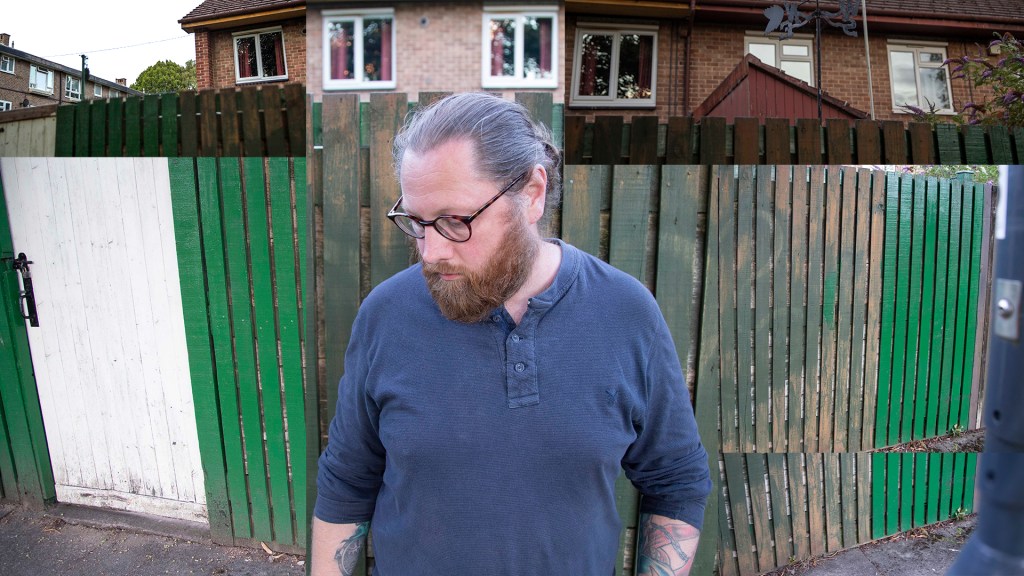
Fig 9. Self portrait behind Dad’s house. Tim Beale 2020
With a desire to explore city nature further,I took to the streets of Bath, not the grand Georgian city people are familiar with but the out of town suburban areas on the outskirts, my Bath.I want to remain true to the core concept of how nature influences our mental state, be it positive or negative, whilst documenting the use of nature in suburban places, such as those I grew up in.
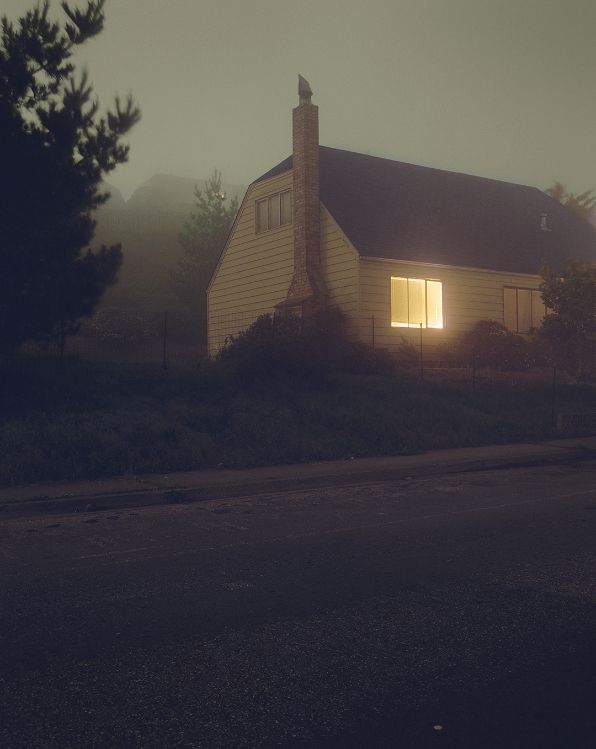
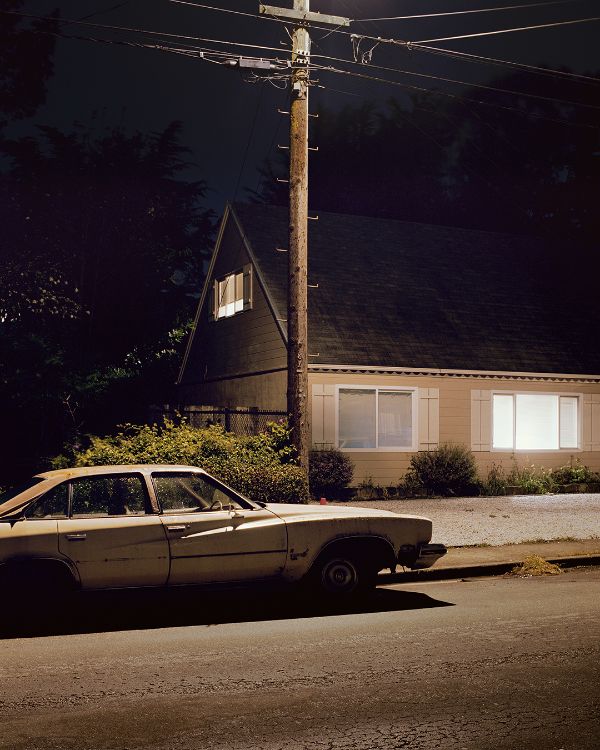
More recently I’ve been inspired by Todd Hido’s – House hunting series of images and have begun shooting at night. I saw in Hido’s images of suburban housing, a sense of mystery, suspense and just a little threat. Hido drives along ‘anonymous’ American streets, most likely in his home of San Francisco Bay area in the US, at night using the light from street lamps to capture images homes devoid of inhabitants.
‘I take photographs of houses at night because I wonder about the families inside them,’ ‘I wonder about how people live, and the act of taking that photograph is a meditation.’ Todd Hido (Christie’s 2017:YouTube)
Fig 10. Todd Hido, 1997. #2027-b
Fig 11. Todd Hido, 1997. #2027-a
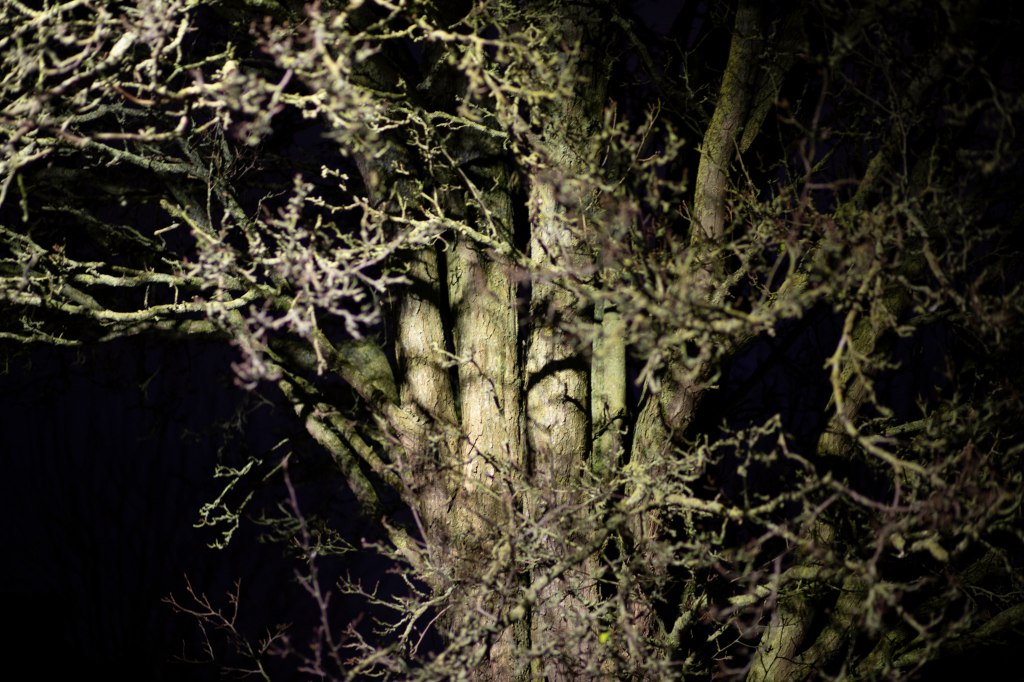
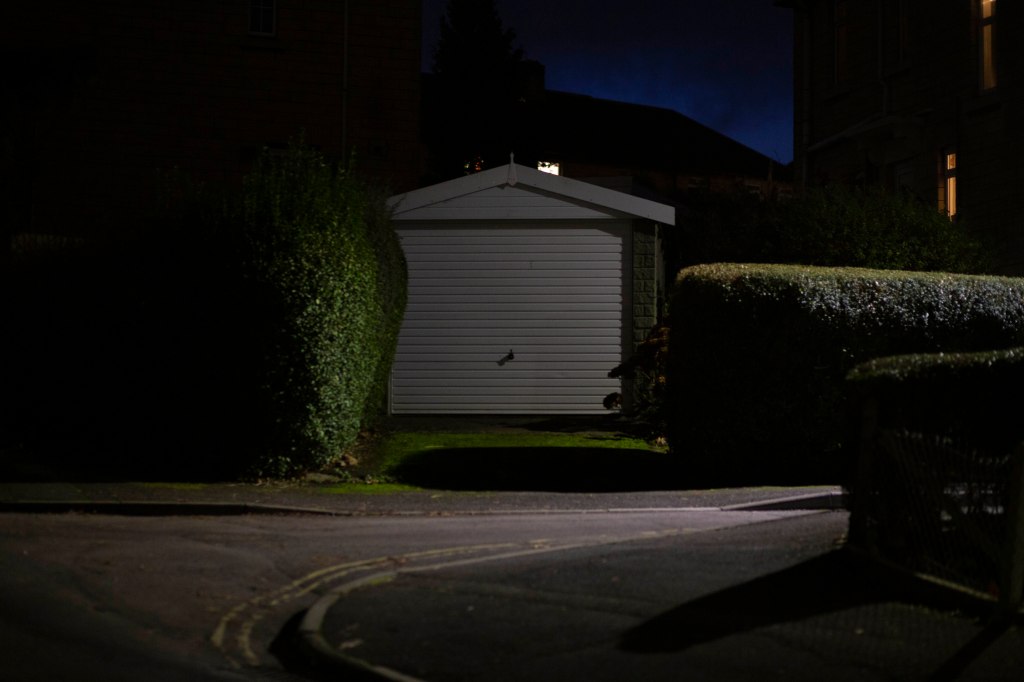
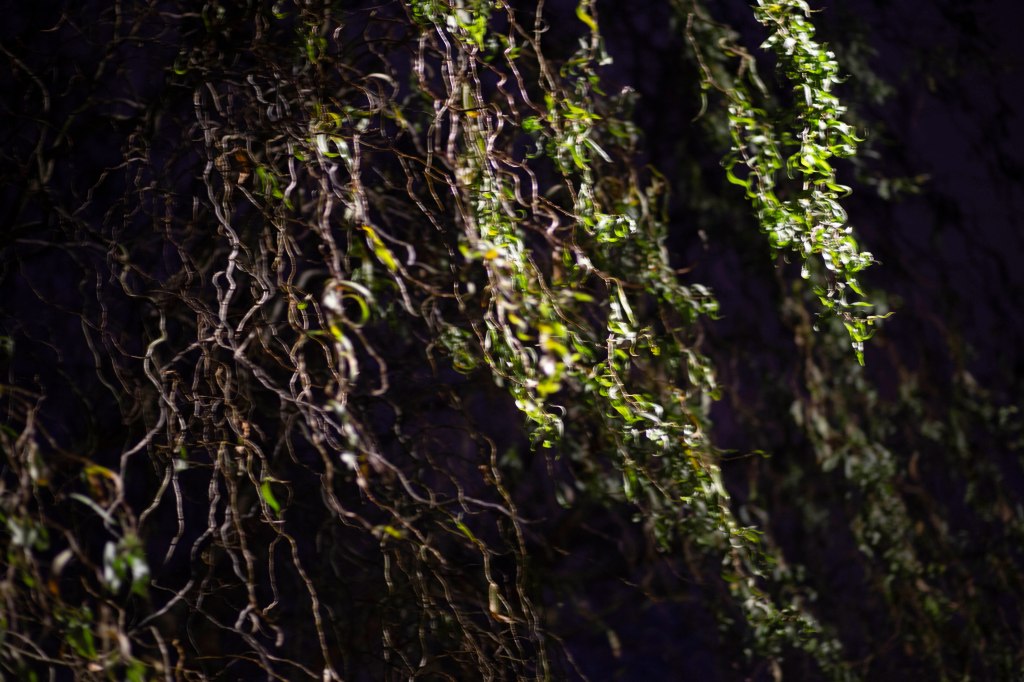
I chose to photograph at night as the quality and effect street lighting can give offers something quite unique. I could have chosen to introduce lighting with flesh or lamp but this seemed unnatural, forced and unnecessary. Trees take on a more central role not having to compete with houses, as these recede into the background. Initially I dismissed the out of focus, blurred images but the more I looked at these the more they spoke to me. The fact that they are blurred not unlike our memories of growing up, some are clear and sharp whereas others are hazy and unfocused.
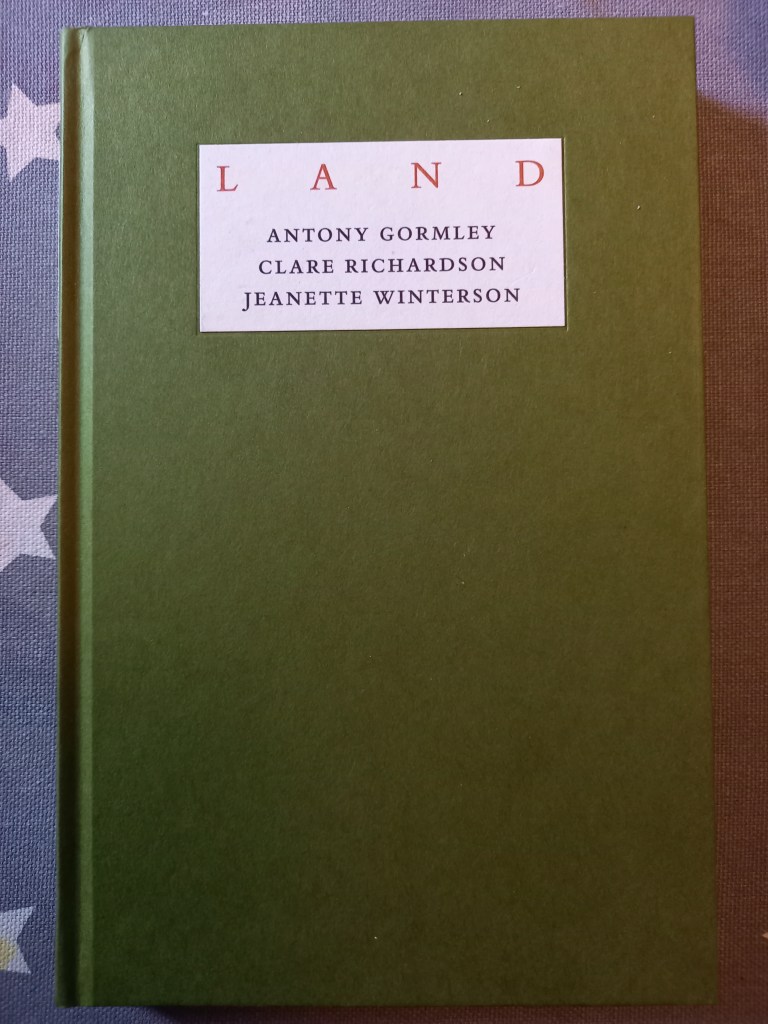
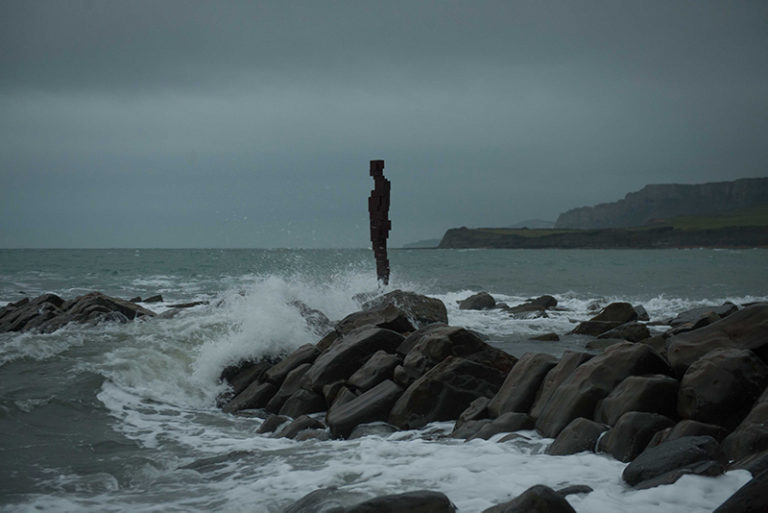
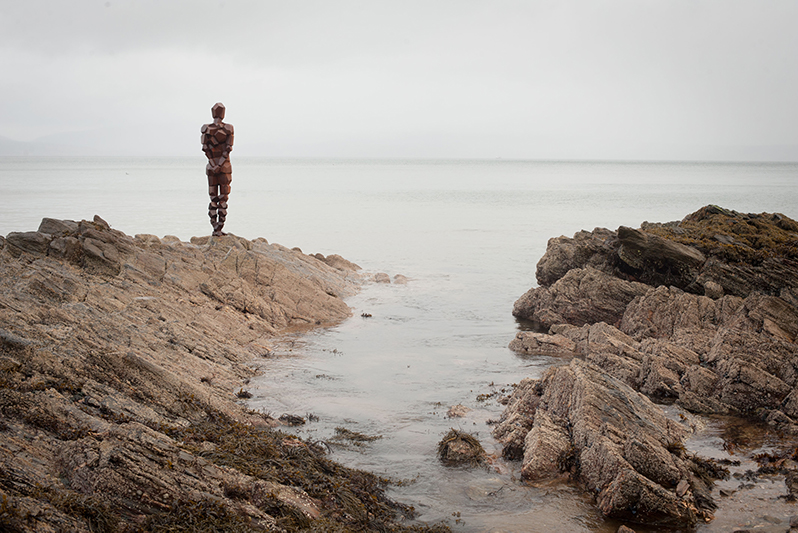
Land is a collaborative book written by Jeanette Winterson with photographs by Clare Richardson of Antony Gormley’s sculptures. The body of work was commissioned by Landmark Trust to celebrate their 50th anniversary and it is an exploration of what it is to be human in remote places across the British isles. Gormley’s sculptures, created out of iron, are solitary figures that appear to stand guide over the landscape and perhaps represent the work done by Landmark Trust in protecting and preserving historic sites.
Richardson’s images certainly capture the context of the installations, with suitability, passion and sometimes calm contemplation she renders soul to each sculpture. You soon forget that these lone figures are not human, it is quite easy to empathise with them as they stand watch over choppy seas and bleak landscapes.
Winterson’s words are written in prose throughout the book, creating imagery of their own. These prose not only describe Gormley’s work beautifully but also have a cohesion with Richardson’s images. Of the images ‘Warrior’ is on such image, the loan figure looking out to sea, standing with arms held back behind its back, waiting and watching. Winterson’s words say it much better:
‘This metal man, both near to and far from our human forms, waits like a warrior-confessor. What is it that you have seen? What is it that you want to say? And I think it would be something to reach the same point of stillness, the end of action and beginning of contemplation.’ J.W
This way of portraying the lone figure really speaks to me and I can see something of my own work in these photographs. Where I use myself in a woodland landscape, I aim to leave the same ambiguity to my imagery that we see in Gormley’s sculptures. Just hinting at a story to be told, leaving the viewer plenty of room to read and interpret.
‘Although these works are temporary placements…’ A.G.
The sculptures where only in place for one year, so this book containing Richardson’s images and Winterson’s word, is the only remaining evidence of this installation. This is not a big ‘coffee table’ photo book but a rather small tome, perhaps A5, hard bound and beautifully printed on Matt paper. The design of the book is such that you can keep it in your pocket when visiting the landmarks trust locations, to read the words, look at the images and become one of these lone figures. A remote human in a remote place.
‘The human body – house of the human being, so fragile, so temporary, and determined to last forever.’ J.W
Resources
Gormley. A, Richardson. C & Winterson. J (2016) Landmark Trust book, ‘Land’
Surrealism is periodically recycled as a style and as described by Andy Grundberg in his essay ‘surrealism runs like a pulse through art photography’s modernist presence.’1 In 1924 Andre Breton published his first surrealist manifesto and was based on the Freudian notions of the subconscious mind as a platform for the artist or art photographer. In terms of photography, surrealism can be seen as the precursor to postmodernism ‘As an avatar of deconstructivist practice and theory, it supplies a rationale both for photography’s position within the art world and for those photographic practices that seek to disorient and disrupt our conventional responses to images.’2
Photographs can be seen as surreal in and of themselves, they act to displace, disrupt and disorientate the viewer. In Susan Sontag’s essay ‘On photography’ she writes:
‘The photographers who concentrated on interfering with the supposedly superficial realism of the photograph were those who most conveyed photography’s surreal properties’3
As with surrealist painting, photography alternates between representational and the ‘automatic’ abstract styles. May Ray remains to this day the anthesis of surrealist photography. His images typically switch between these two styles, his images such as ‘Le violon d’Ingres’ are pure constructs, choreographed and designed, whereas his ‘Rayographs’ rely upon a more random act of chance or pure experimentation.
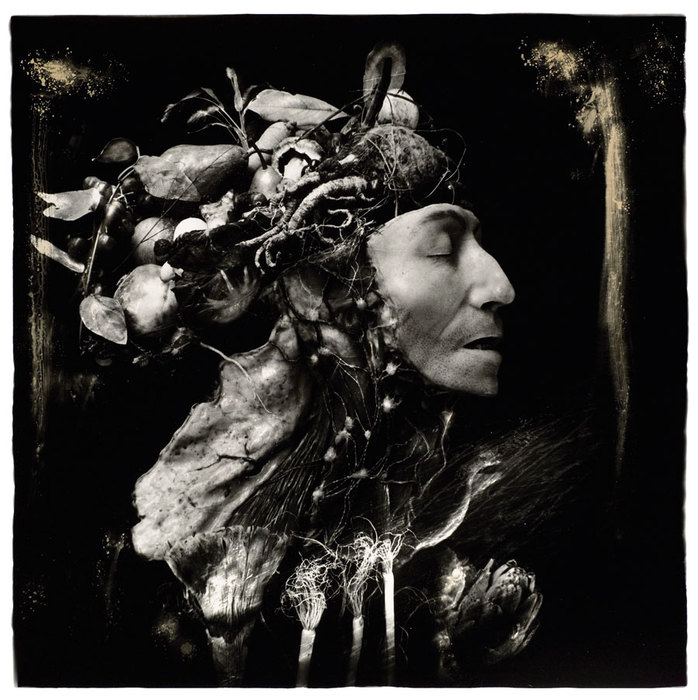
More contemporary photographers have a tendency for the grotesque or theatrical such as the work of Joel-Peter Witkin, Frederick Sommer and Les Krims. If we first look to the work of Witkin who’s images are meticulously constructed and often grotesque featuring disembodied limbs to create dreamlike still life scenes. Wikin’s image ‘Harvest, 1984’ is something akin to the 17th Century Flemish painters with their images of fruit and game but offers a more macabre interpretation.
Harvest, Joel-Peter Witkin
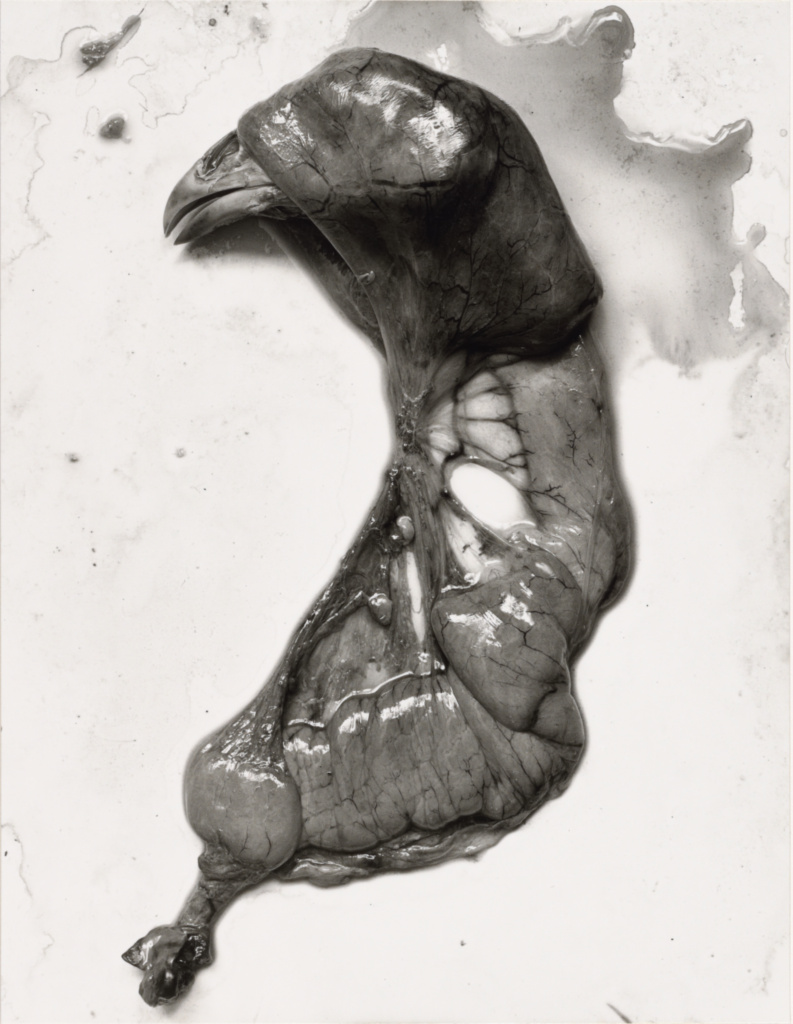
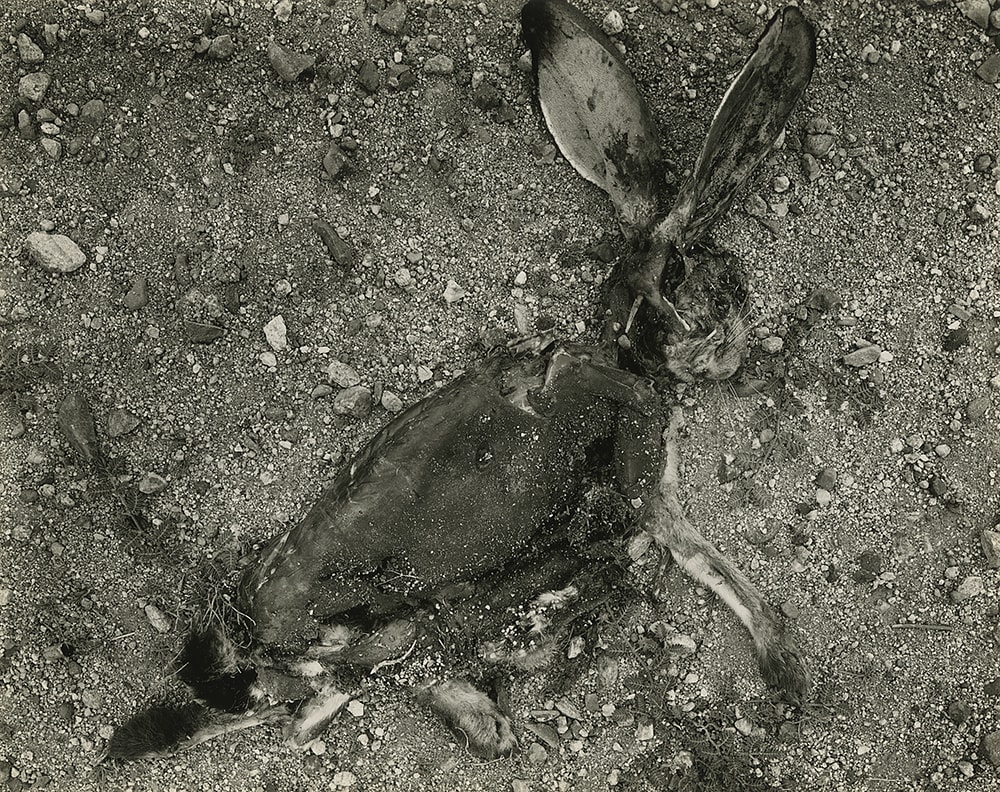
Frederick Sommer’s images can be seen in the same vein as Witkin’s in the use of the grotesque to illicit a reaction from the viewer. However, unlike Wikin, Sommer does not (obviously) arrange his subjects, there are no fancy set pieces. Images such as ‘Chicken’ and ‘Jack rabbit’ are more automatic in the sense of a document of something found. This sits well within the origins of surrealism and that of tapping into the subconscious.
‘Chicken’ ‘Jack Rabbit’ Frederick Sommer
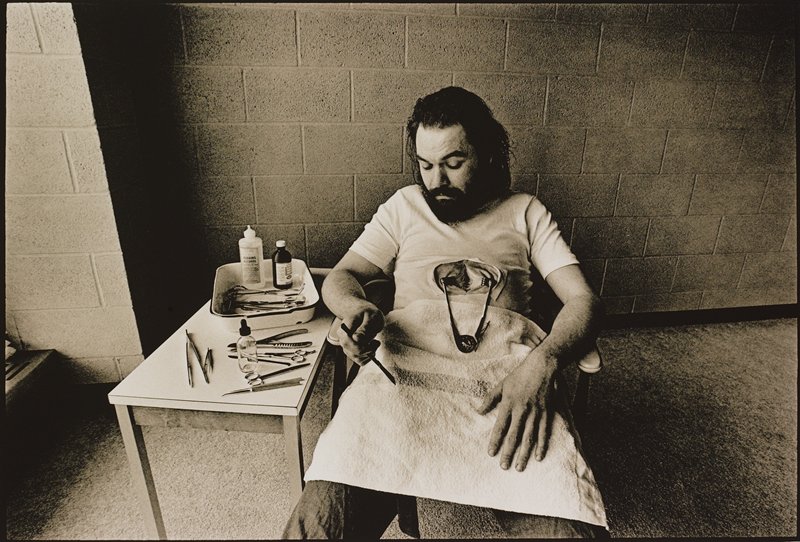
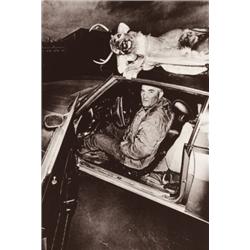
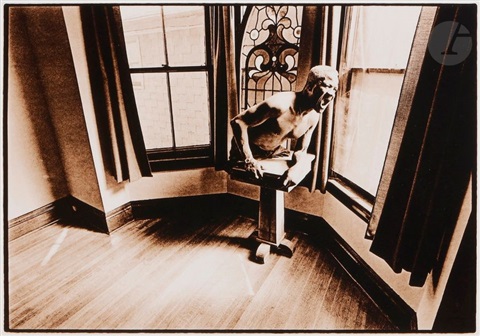
Bridging this divide of styles is Les Krim’s work, that has a mix of autonomous and choreographed images, ‘self-operation’ appears choreographed whilst ‘Deer slayer’ looks to be a documentary image of strangers coming back from a hunt. Of the three photographers I am more drawn to Krim’s work, perhaps because of his use of the human form as in ‘Human Being as a sculpture’ or because there is a simplicity to his work that connects with my subconscious.
Self Operation, Les Krim
Deer Slayer, Les Krim
Human Being as a Sculpture, Les Krim
There is something to be said about subtlety, especially in surrealism as all too often images that have been described as surreal are over thought. This was an issue that Breton had with the work of Salvador Dali, in fact many of the Parisian surrealists shunned Dali having said his work to be too contrived and controlled to have come from the subconscious. The same could have been said about Yves Tanguy, who’s work is comparable to that of Dali. Photographers who work in a similar styling of Dali are Jerry Uelsmann and Clarence John Laughlin, whilst illustrating something dreamlike their images my lack the subtlety that I admire in early surrealist work, especially when comparing to Man Ray’s iconic image ‘Les Larmes’.
The Space Between: Birth & Death, Tim Beale 2020
References
1 Grundy. A (1990), Bay Press, The Critical Image: essays on contemporary photography, ‘On the dissecting table: The unnatural coupling of surrealism and photography’ pp. 80.
2 Grundy. A (1990), Bay Press, The Critical Image: essays on contemporary photography, ‘On the dissecting table: The unnatural coupling of surrealism and photography’ pp. 86.
3 Sontag. S (1979) Penguin Books, ‘On Photography’ pp. 52.
Following a very constructive 1:1 with my course tutor I have had time to reflect upon our discussions around my project and look at next steps forward.
Looking at close up / details of the objects that make up a particular space
What are the finer details that make that space special, what am I drawn to when visiting it?
Do all images need to have a figure in order to tell the same story
Further research into the bond between the human psyche and the natural environment
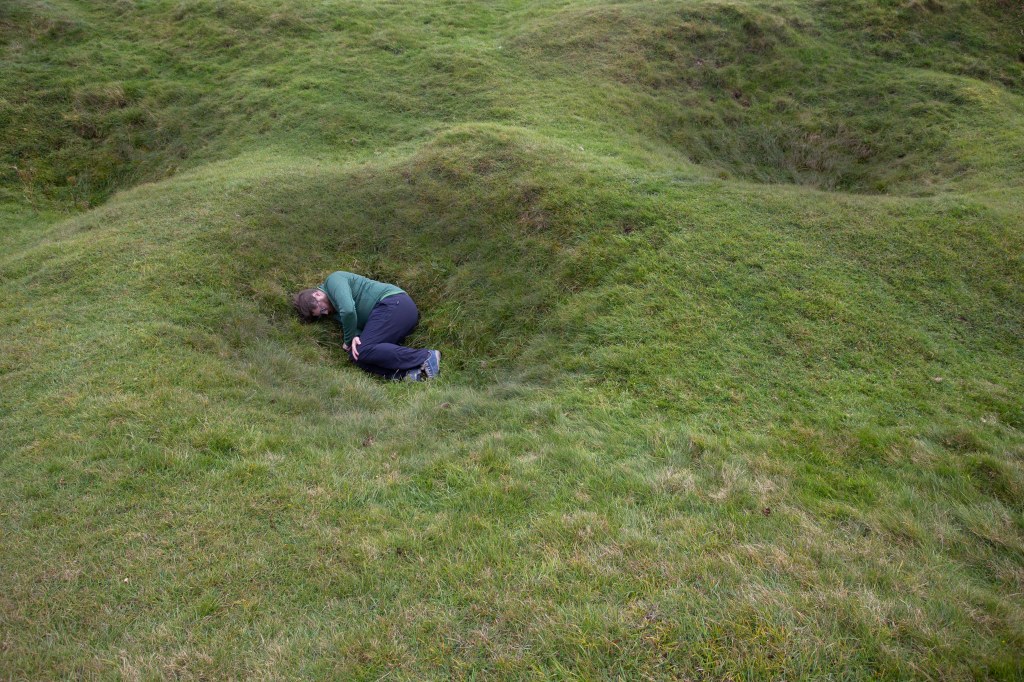
The key discussion was a round how my project has become the Space between birth and death (from womb to tomb), is a psychogeographical journey through life exploring the environment that shapes our life. From the biophilic desire to seek out nature as healer to the genetically imprinted need for a safety. We associate places with memories and often key events in our lives are linked to a specific place. This entry for my CRJ has taken a long time to right as during the past few weeks I have been coming to terms with loosing my father, who died suddenly on the day he was due to come home from hospital. Since my fathers passing a few weeks ago I have been reassessing my connection with life and how this impacts on my project. There are so many key moments in my life that are connected with a place. When thinking back to an experience so much of that is the where. I want to convey this in my project. For me nature is my salvation, where I escape to, where I feel safe away from everyone else. Into natures welcoming embrace.
Tim Beale, The space between: Death, 2020
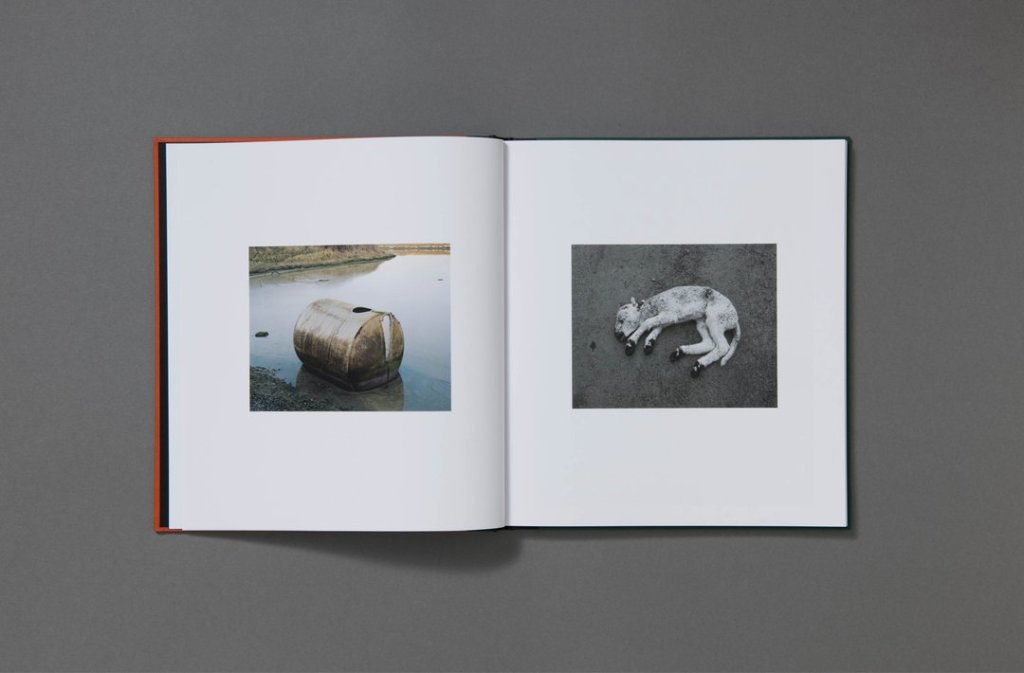
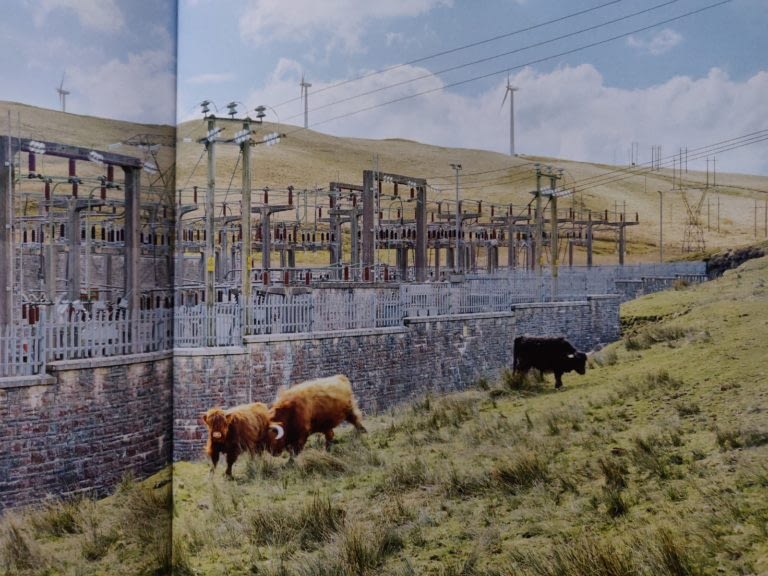
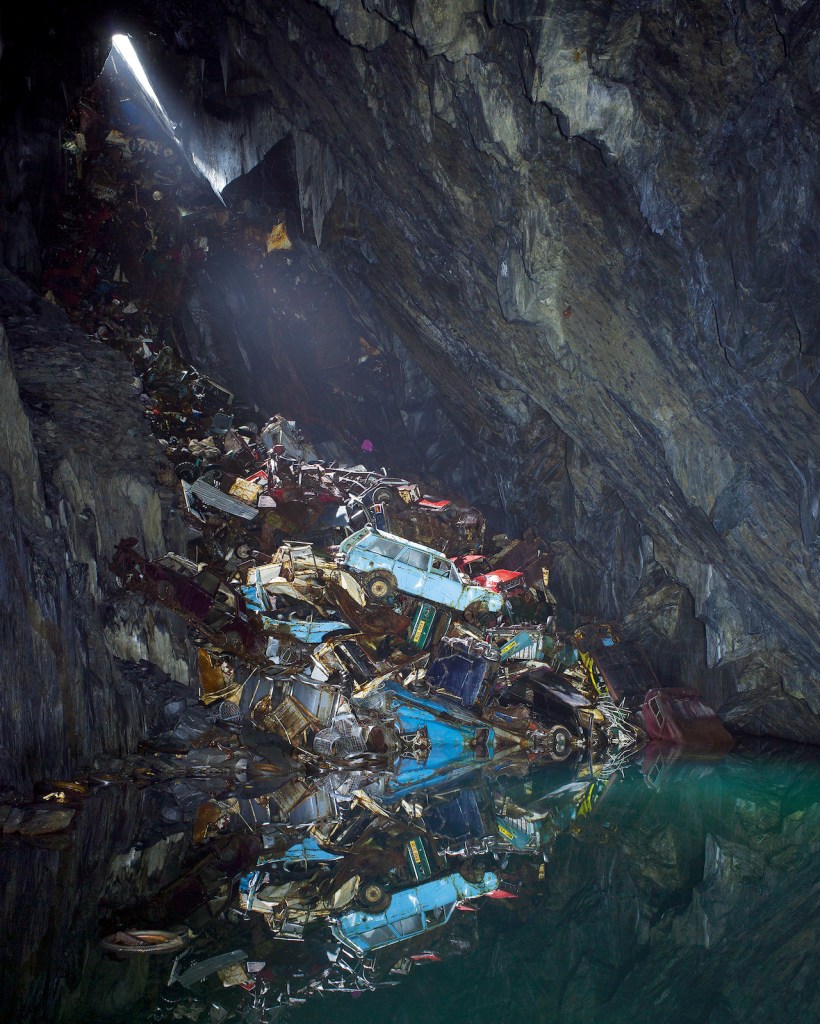
After my tutor’s feedback two pieces of work that I have started look at are Robin Friend’s ‘Bastard Countryside’ and Sam Taylor-Wood’s ‘Still Life’, both very different practices to look at but hold a certain resonance for me. Friend’s book ‘Bastard Countryside’ is a collection of images taken over a fifteen year period and influenced on what Victor Hugo called the ‘bastard countryside’: “somewhat ugly but bizarre, made up of two different natures”. With many images having the appearance of a classical landscape these are off set by the depiction of dilapidated or stark industrial architecture, these images are then paired with detailed shots of industrial waste, obscure debris and the discarded. Overall this appears a bleak representation of the British landscape, however is all the more refreshing for it. Having grown up in the Midlands, an industrial landscape scattered with the lost a forgotten structures of a long gone industry. I enjoy the use of images of the details that are to be found within these landscapes, almost evidence of lives lived.
Robin Friend, Bastard Landscape 1
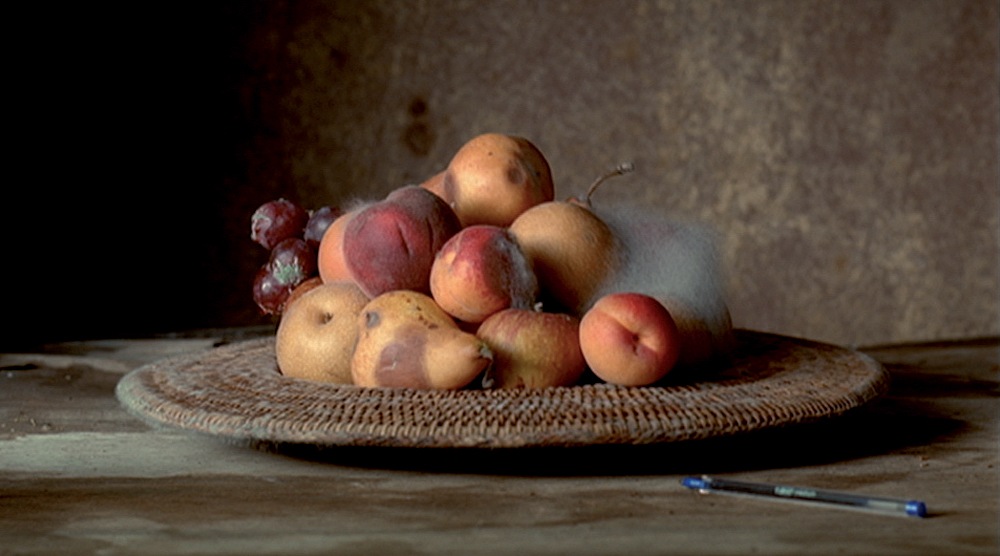
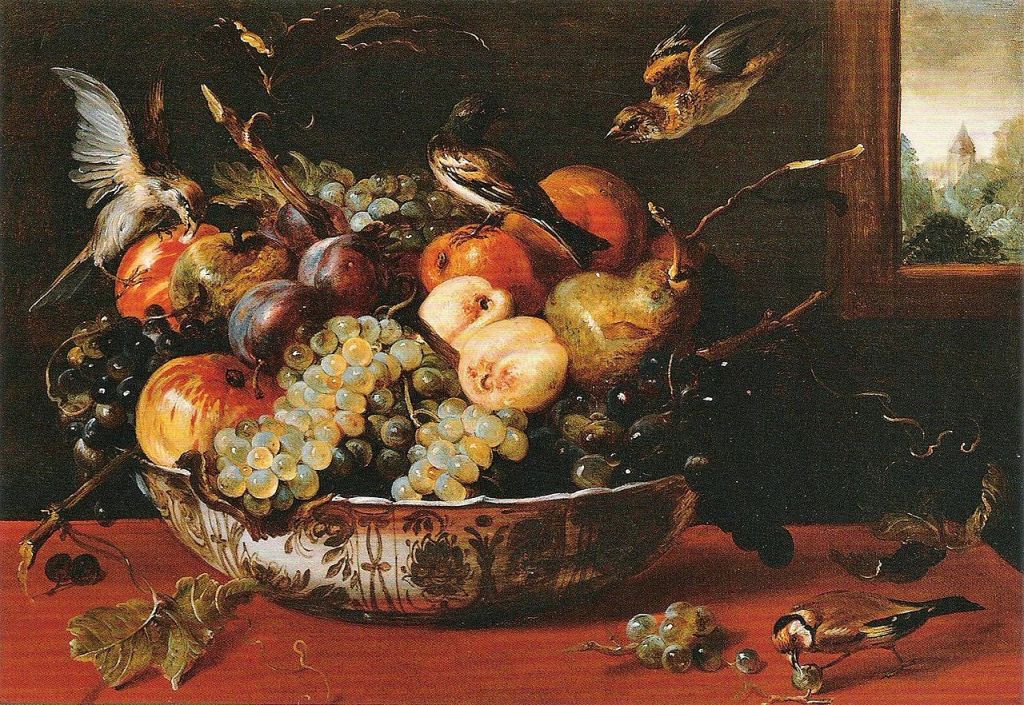
Sam Taylor-Wood’s video-graphical ‘Still Life’ holds a different level of fascination, where Friend looks to capture something of the lost or past, Taylor-Wood looks to depict the transition of time. The use of stop motion photography show’s the decay of fruit, perhaps five weeks or so, over the space of around 4 minutes. The lighting and scene are reminiscent to the early Flemish still life’s of the 17th Century. However as the Flemish painters desire was to show the viewer the wealth and abundance of nature, whereas Taylor-Wood’s videos show us the fragility and mortality of nature. This is a really interesting concept and has peaked my interest but for me I want the viewer to take each image or collection of images and interpret each as a moment in life, rather than the passage of time.
I had a really useful feedback session on my research project at this week’s webinar, after presenting my latest images and areas of research we then discussed how my project had evolved over the course of the MA. Having research such photographers as Jeff Wall, Rachel Harrison and Tom Hunter, I can now see a tangible style that my practice is moving towards. The use of tableauxs in my photography has been incredibly useful in enabling me to explore my own response to the environment around me. This is not without it’s challenges and risks. Whilst choreograph, direct oneself is infiltrate easier than using a module, controlling a shot becomes that more challenging, I use a spare mobile phone tethered to my DSLR to over come this. I have however had to be ever mindful of locations and the risk of theft or injury to myself (slipping down a hill side), as much as possible I’ve tried to go out with other family members or friends.
Reviewing my images from that last few weeks has been particularly enlightening as it is clear that there has been a substantial (subconscious) shift in context, from simply looking at the space around us, towards investigating the space between Birth and Death. I feel this shift in focus is ever more poignant to me now, having suddenly, just lost my father. Much of my current work reflects this transition in thinking and feeling, tangible motifs can be seen such as that of birth. Over the next few weeks I will begin to explore other aspects of that space between Birth and Death as I look to self reflection as my own way of dealing with grief.
The from the womb to the tomb – the space between. Tim Beale 2020
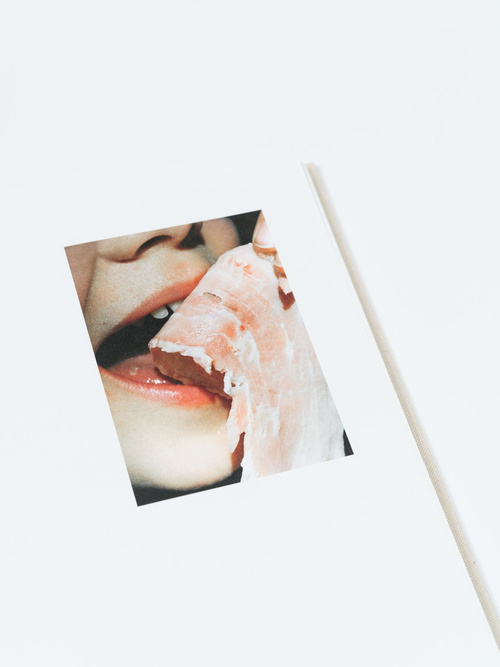
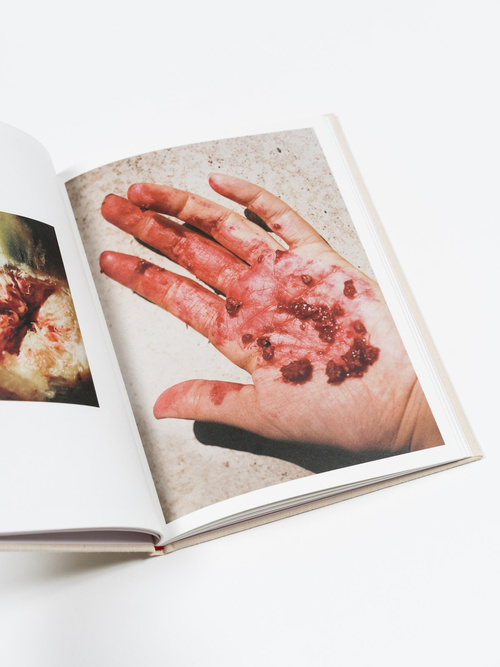
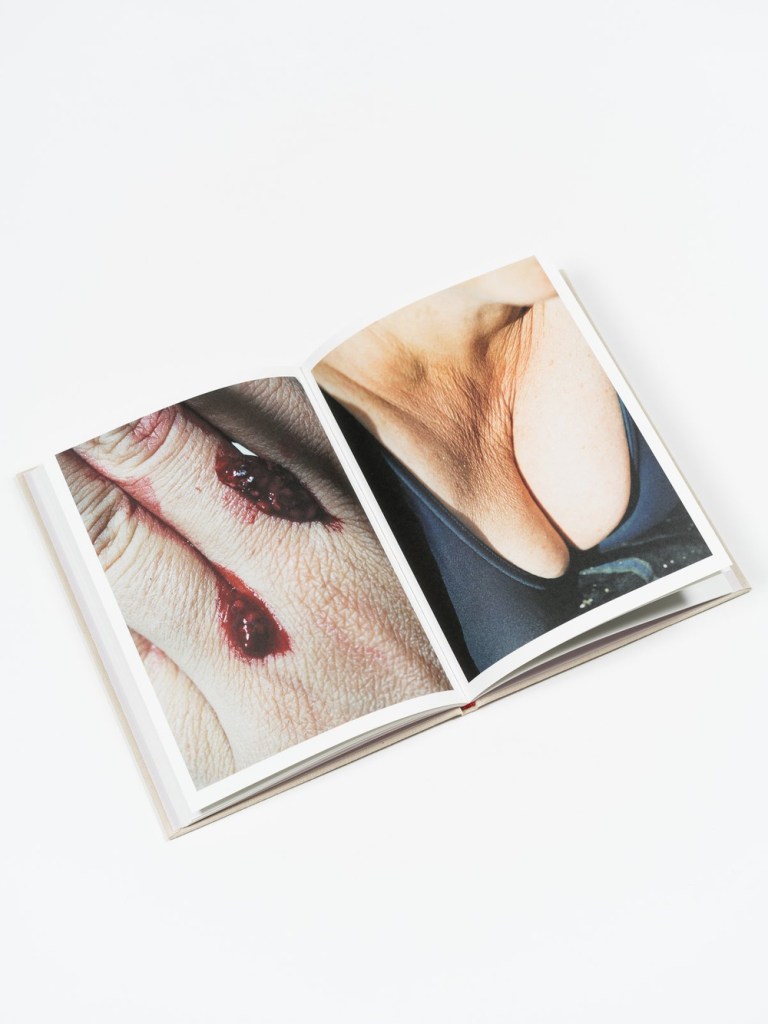
It was suggested I look to the work of Lucile Boiron’s book ‘Womb’ where she “explores and exhausts fragments of flesh, these moments when human nature appears for what it is, that is, perishable. Far from making an inventory of the feeling of revulsion, she questions the body’s biological truth, and attempts a photographic answer to the issue of good and bad taste.”1 The book is a well thought out and curated body of work with close up images often paired in such a way that makes the viewer uncomfortable, such as the use the flesh of fruit juxtaposed to images of blemished skin. Looking at more of Boiron’s work it is clear that the body itself is the focus with the environment being absent or playing a minor part in her imagery.
Lucile Boiron, Womb 2019
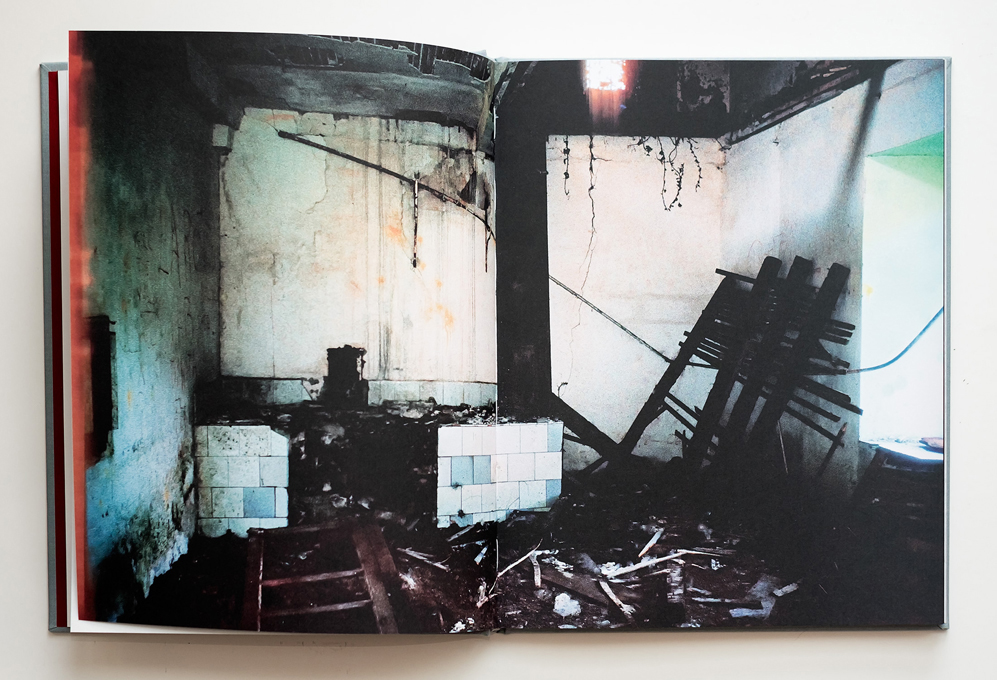
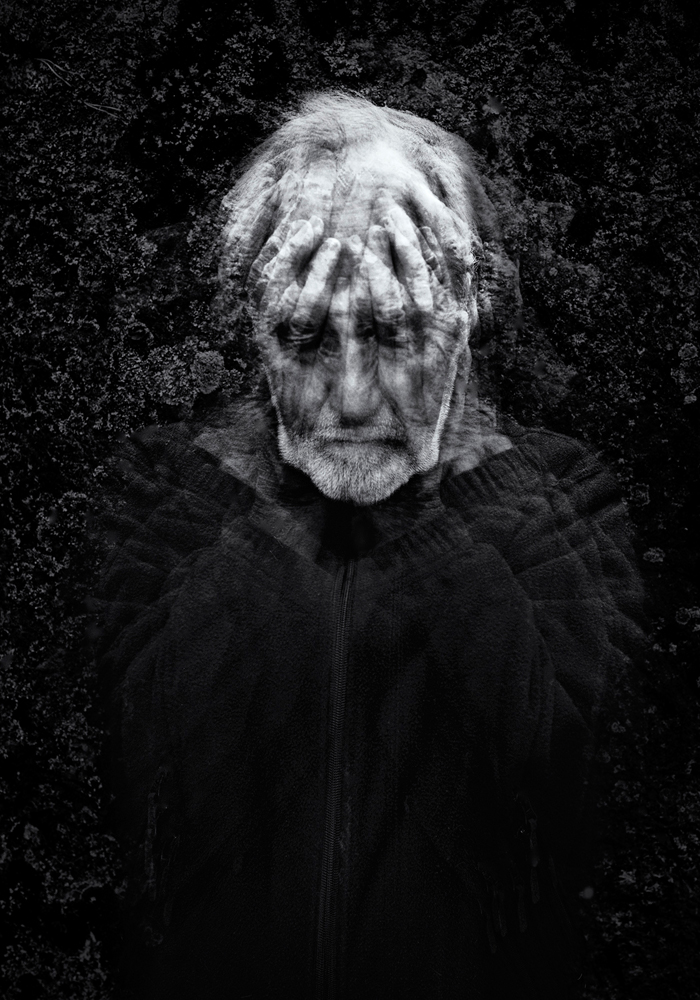
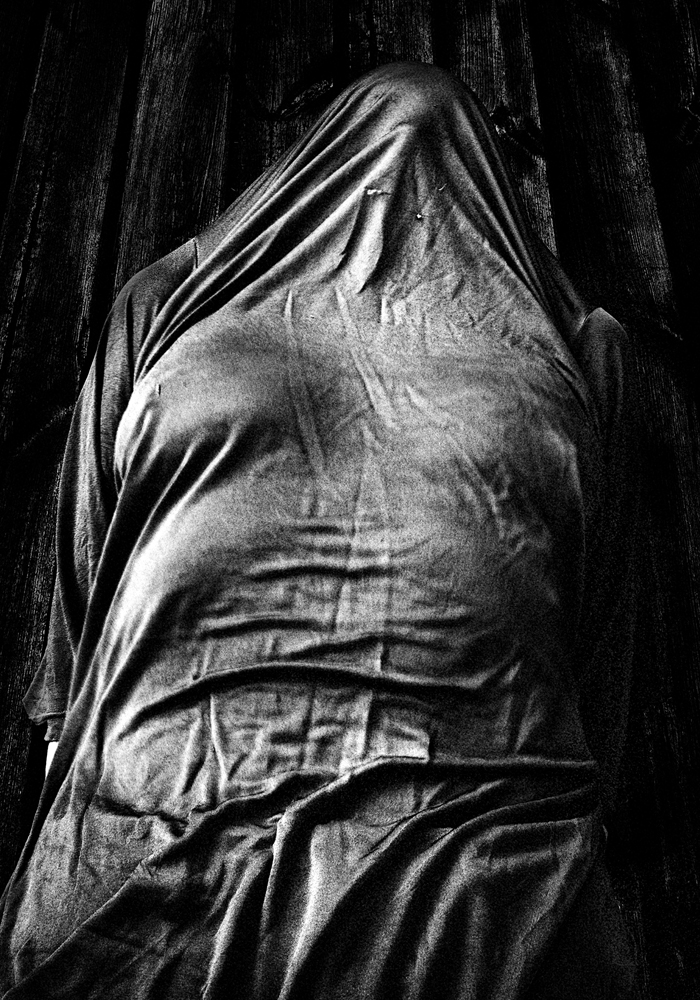
I also looked at the book ‘Endings’ by photographer Leif Sandburg, “About panic and getting old” as he describes it2. Sandburg then in his late ’60s he received the difficult news that he had cancer this led him to consider his mortality, six years later after extensive surgery and a great period of photography ‘Endings’ was produced. As opposed to Boiron’s work Sandburg uses the environment in his images to draw parables between the fragility of human existence by offering the viewer images of decaying structures and interiors, often in colour, set against stark monochrome images of figures (mainly self portraits of Sandburg). Sandburg’s use of techniques such as multiple exposer gives an ethereal, ghost like motion to the figures depicted therein.
“Death becomes palpable when it approaches, and the pictures contain questions of fear and uncertainty, but simultaneously the joy of ageing together with a life partner. The pictures have grown over a five-year period. Often a photo session with an original idea inspired new pictures created in the moment and the plan had to give way for intuition and guts feeling. Possibly a way to get close to who you and exploring your inner self.” –Leif Sandberg 2017-03-013.
Leif Sandburg, Ending 2017
Of the two photographers Sandburg’s work has a certain resonance to my own current project. Whereas the brutal beauty and curation of Boiron’s book is truly inspiring, leaving me with questions about curating my own images and how they can be used to effect such strong reactions in the viewer.
In Charlotte Cotton’s book ‘the photography as contemporary art’1 she sets out each chapter under a theme, in the chapter ‘once upon a time’ one such theme is the tableau photography (or tableau-vivant). Tableaux photography concerns the story telling in contemporary art photography with images that make reference to fable, fairy tales, modern myths and apocryphal events that are all part of our collective consciousness.
Tableau Vivant transalates from French meaning living picture, is not a new technique exclusively used by photographers but one that has its roots in 17th & 18th century paintings. The narative is often concentrated in a single image (which may become part of a series) with the scene choreographed for the viewer, using recognisable (conscious or subconscious) motifs, symbols or props that elicit a memory or emotional response.
Jeff Wall ‘Flooded Grave’ 1998-2000
One of the most prolific users of the tableau is Jeff Wall who’s images are created from scenes he has witnessed or memories, these he meticulously recreates. Wall’s exhibition ‘Tableaux Pictures Photographs’ 1996-2013 we see images such as ‘Flooded Grave’ in which an open grave has been filled with water and sea life, such as star fish and sea urchins. This is typical of the way in which Wall plays with the tension between the real and the unreal. For Wall it is the way in which we will voids with our daydreams, in our daydreams we see what isn’t there. When exhibiting his work, Wall uses large light boxes to display his colour images, giving them a luminosity that adds a hyper real quality to them which is turn confronts the viewer with the drama in front of them. The images become more than a photo and more akin to a lit stage. Wall a post graduate in art history has a deep understanding of how space is full of relationships and how to construct a visual scene for the viewer.
“they [Wall’s images] are evidence of a detailed comprehension of how pictures should work and are constructed.” Charlotte Cotton
Tom Hunter ‘The way home’ 2000
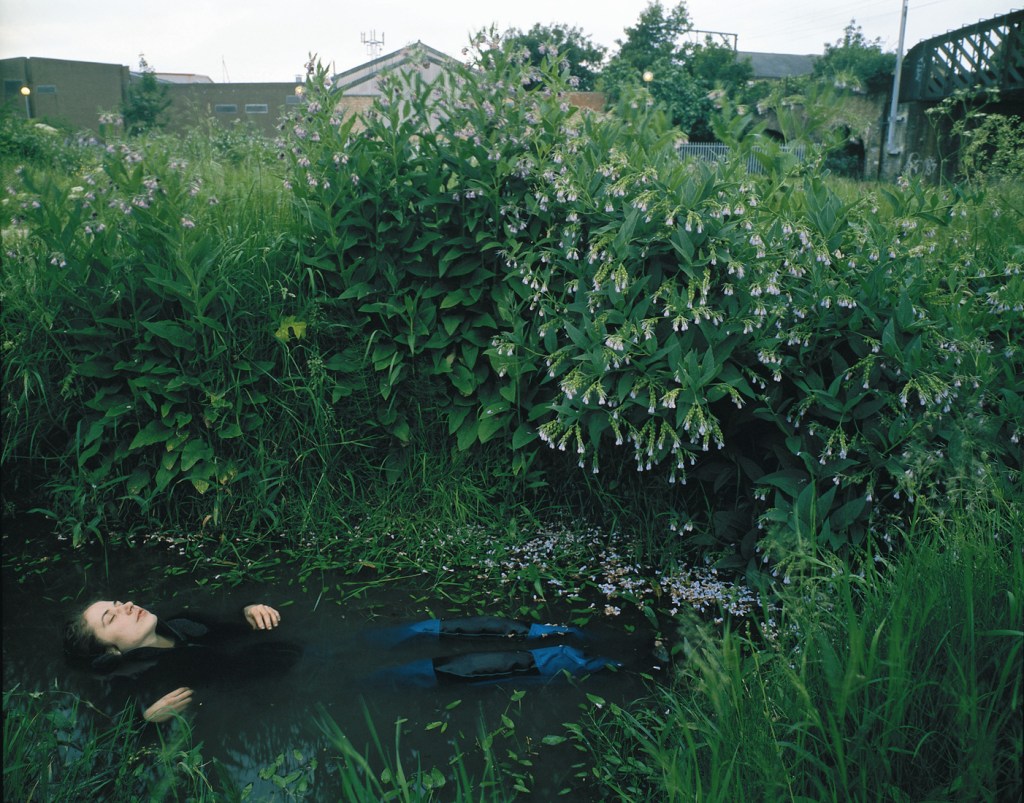
For his tableau’s the British photographer Tom Hunter reworks the images created by Victorian painters such as the Pre-Raphaelite Brotherhood, especially in his series ‘Thoughts of life and Death’. One image from this series ‘The way home’ 2000, is a direct translation of John Everett Millais’s2 ‘Ophelia’ (1851-52) which depicts the tragic character from Shakespeare’s play ‘Hamlet’. In Hamlet the drowning of Ophelia is not actually acted out on stage but rather delivered in poetic verse by Queen Gertrude [Hamlet Act IV]3. In Millais’s painting he has depicted the moment Ophelia has fallen from the broken branch into the brook and begins to sink without a struggle, calmness upon her facial expression. The artist gives form to the poetic description beautifully. As with Millais’s painting, Hunter’s image is rich in detail showing the English landscape however brings this into a contemporary setting by the inclusion of a metal foot bridge and rooftops of modern housing. The use of a dead pan expression on the figures face engenders in the viewer a sense of anxiety and uncertainty of the context or meaning, resulting in the viewer questioning the scene before them.
John Everett Millais ‘Ophelia’ 1851-52
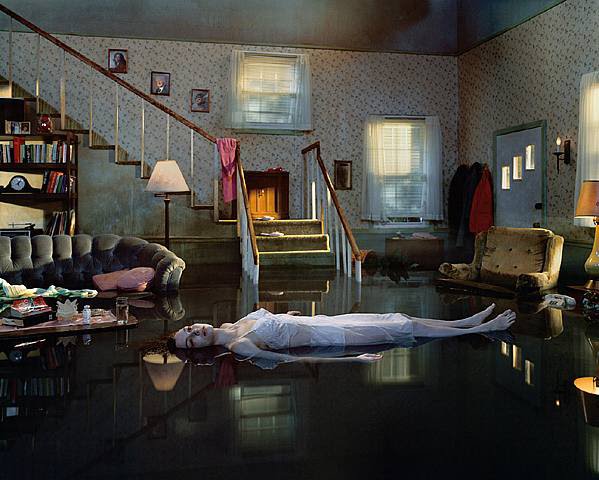
Gregory Crewdson also adapts the Millais painting for his own narrative in his ‘The Twilight’ series. ‘Untitled’ (Ophelia) 2001. Whereas Hunter depicts a girl drowned on her way home from a club, Crewdson’s image shows his Ophelia as a typical American suburban housewife laying lifeless in a flooded home. In the documentary 4 ‘ The aesthetics of repression’ 2004, Crewdson discusses his interests in the psychology underlying the American suburban experience. As a side note, Crewdson’s father was a psychiatrist who had his office in the basement of their family home, a motif that appears in many forms of his images. Each tableau that Crewdson creates is akin to the elaborate block buster movie sets, using huge teams to create scenes of suburban live within the studio. The use of large sets and actors gives his images the appearance of movie stills, frozen scenes of action. Influenced by artists and movie directors such Hopner, Spielberg and Hitchcock, Crewdson’s images have a dramatic almost sinister nature to them.
Gregory Crewdson ‘Untitled’ (Ophelia) 2001
Often tableaux photography will employ pictorial devices to throw questions, a sense of the unknown about the meaning or context. Such devices are often subtle as a turned head, figures facing away from the viewer or a dead pan expression. As with each of these photographers, within my own practice I have experimented with how the image is choreographed, dressing the set, lighting and how the figure is represented within the image. When looking at the space within an image I feel that in order to give the space meaning there needs to be a human presence. If there isn’t someone there to experience the space does the space exist? The use of tableau photography in my practice is a clear method to illustrate this.
The space between: Birth & Death, 2020, Tim Beale
Resources
1 Cotton. C, (2011) Thames & Hudson, ‘The photograph as contemporary art’ pp. Pages 54-71.
2 Hilton. T (1991), World of Art books, ‘The Pre-Raphaelites’, pp. 77-81.
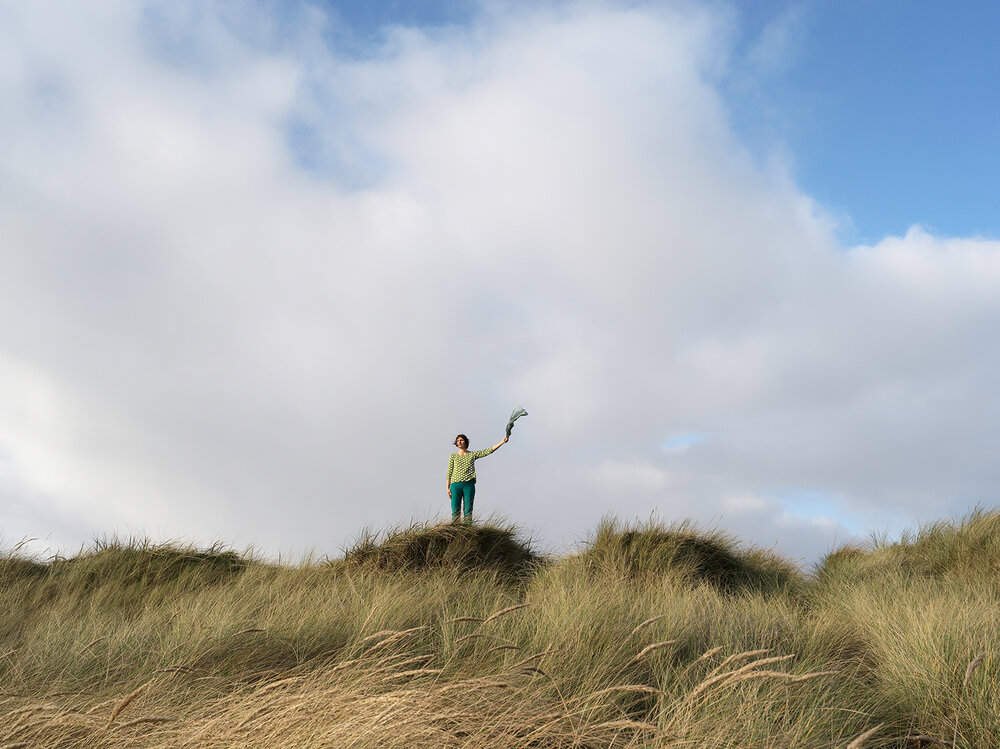
Elina Brotherus: can be described as a biographical self portraitist who’s images show the photographer performing her self histories. Brotherus’ use of colour in her imagery is subtle but effective. The setting of her shots either interiors or landscapes appear in muted delicate colours, tones and more often than not naturally lighted. This can be seen in the ‘Measuring Wind Speed’ series especially in the ‘Neiblem’ image where the choice of vivid green clothing works to contrast against the grey sky, whilst acting as a visual link to the wild grass in the foreground. Brotherus is visually rooting to the earth and unable to be blown away by the wind.
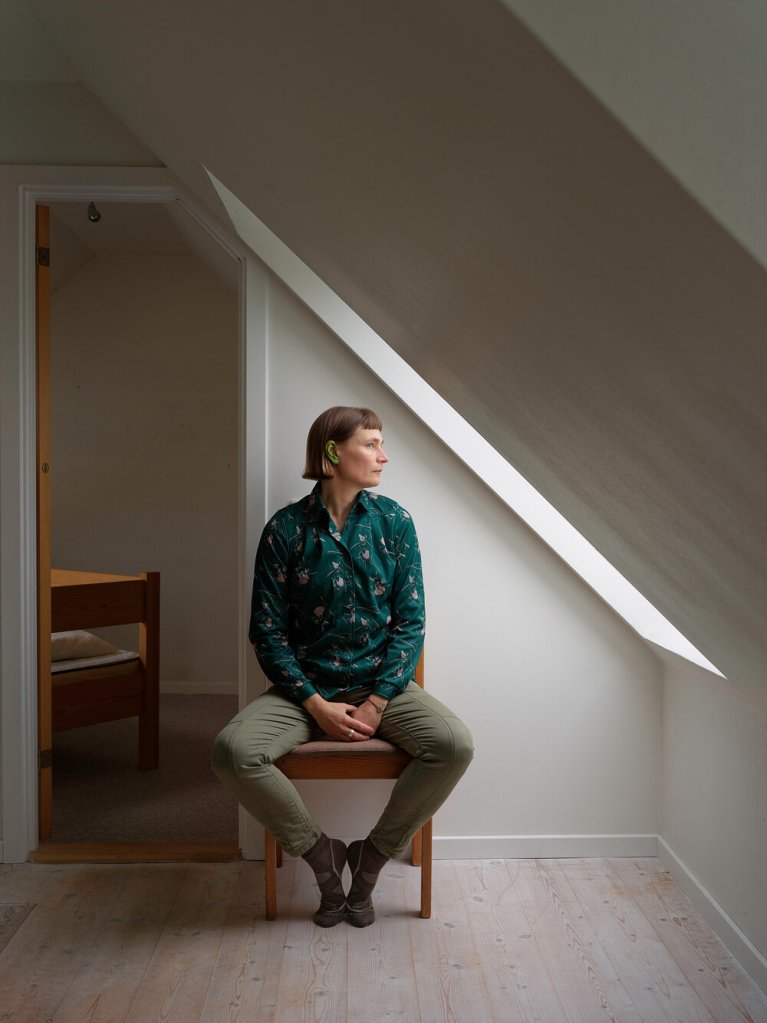
Das grüne Ohr 2, shows how Brotherus uses her choice in clothing to contrast the muted tones and shades of the interior to draw the attention of the viewer. Whilst the two spaces we see are cool shades of grey, the positioning of the wooden furniture parallel to the door and its frame draws the viewers eyes around the image and towards the sitter. Here Brotherus is dressed in green, this use of green is further exaggerated by her ear that has been painted green. She is seated looking out of a window, the use of green reminds the viewer of landscape and nature, perhaps this is what she sees out of the window.
‘Das grüne Ohr 2’ Elina Brotherus
The use of natural lighting from the window helps to throw the bedroom into shadow further contrasting with the solitary seated figure. This is used cleverly with minimal furniture to distract the viewer. Hands clasped and feet on points, akin to a ballerina, this is far from a relaxed pose. It is almost as though Brotherus is preparing to flee, perhaps through the window and into the landscape beyond.
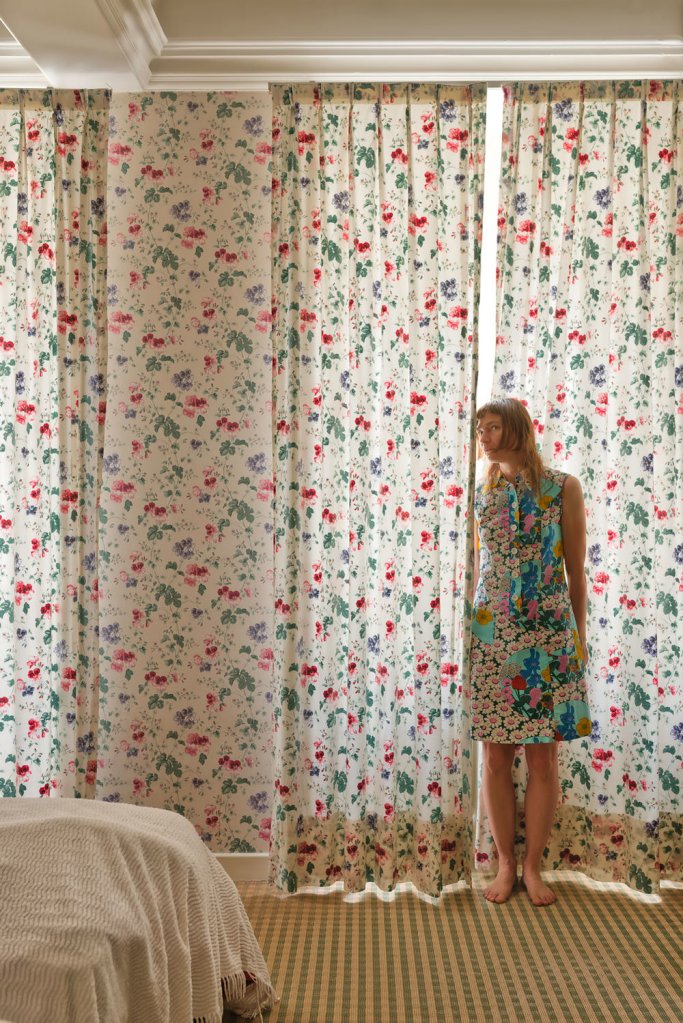
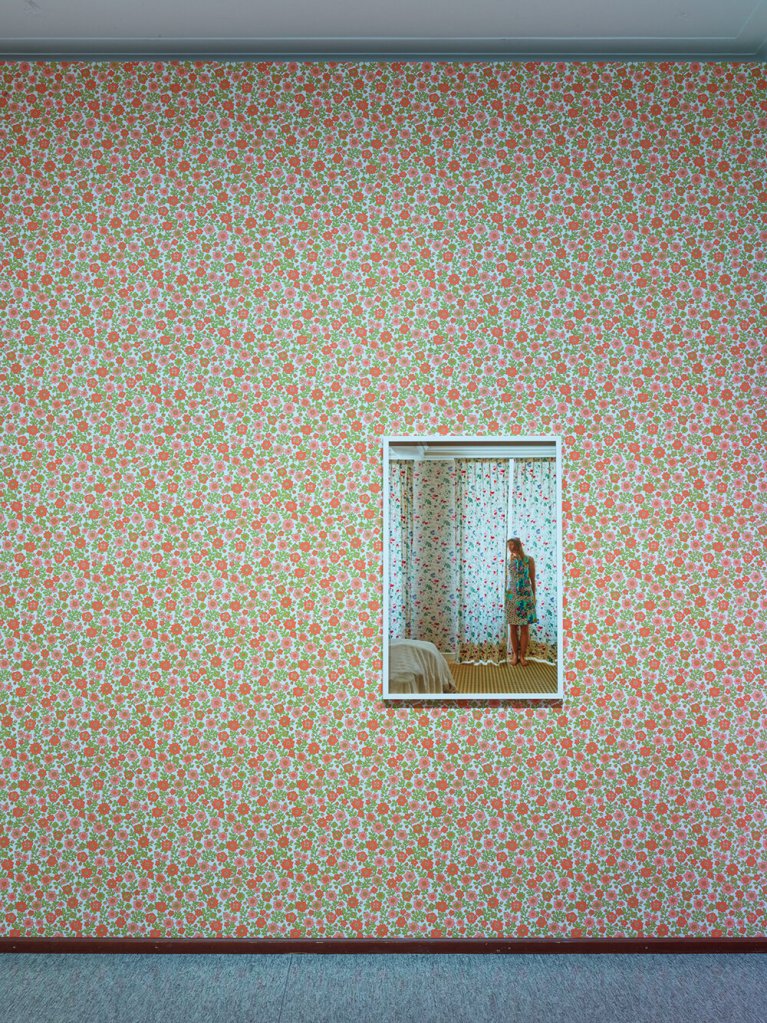
Images from exhibition installations show how Brotherus further uses colour to exaggerate and extend from the boundaries of the initial image. This is evident in ‘Bad Camouflage’ in which Brotherus is dressed in a heavily floral dress almost hidden against floral curtains and wall. Both the curtains and wall paper are of the same pattern, this wall paper is then used in the installation. As a result the image becomes almost lost, camouflaged against the floral wall paper.
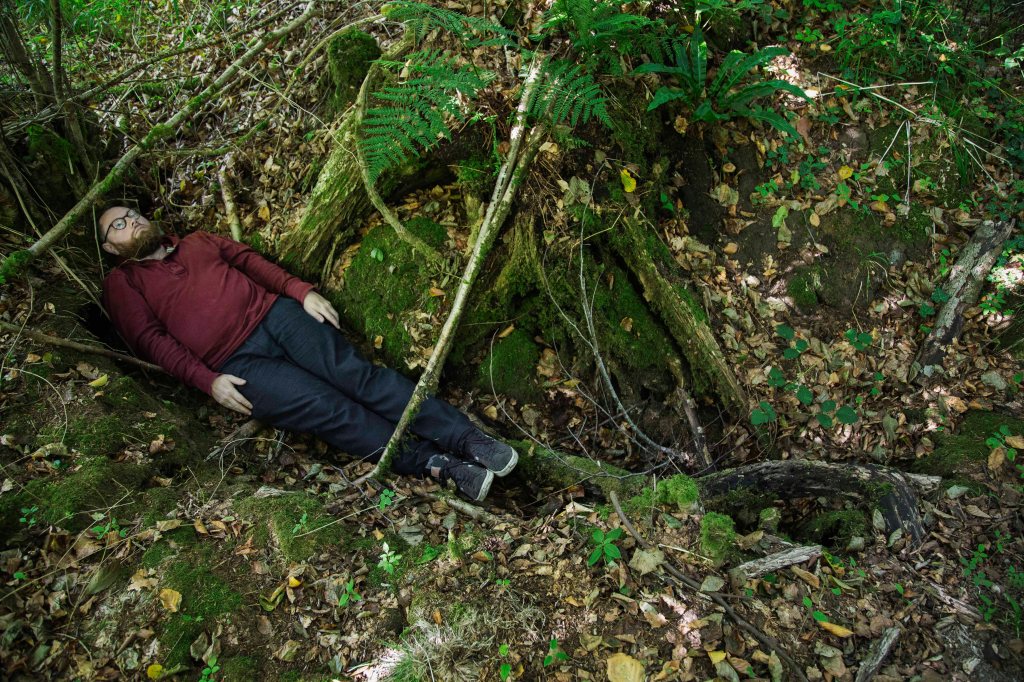
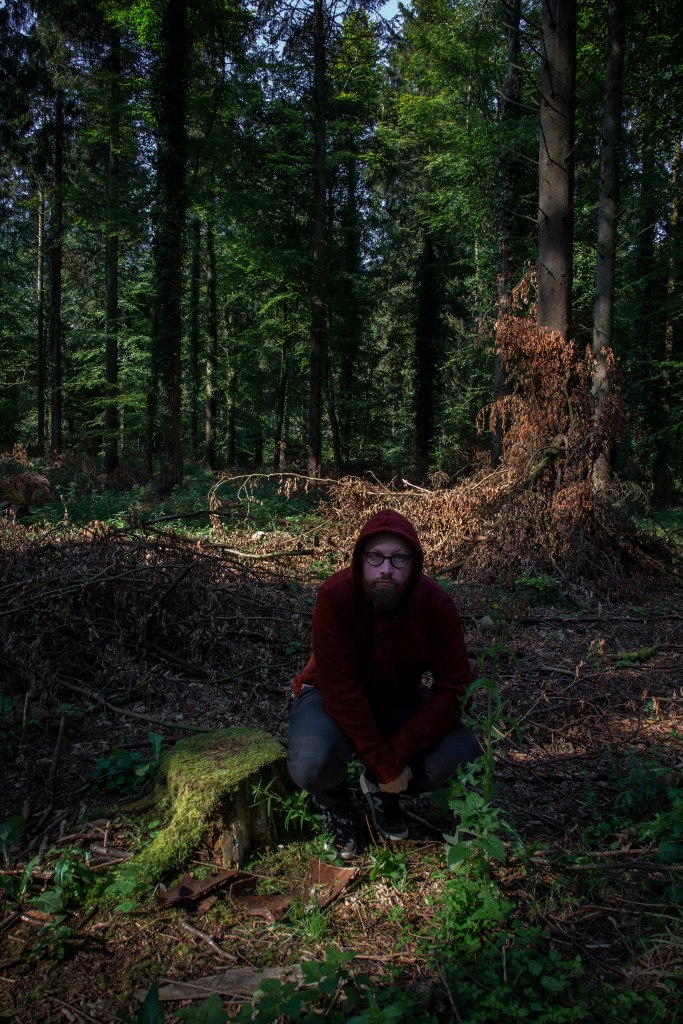
‘Bad Camouflage’ Elina Brotherus‘Big red riding hood – underground’ Tim Beale 2020
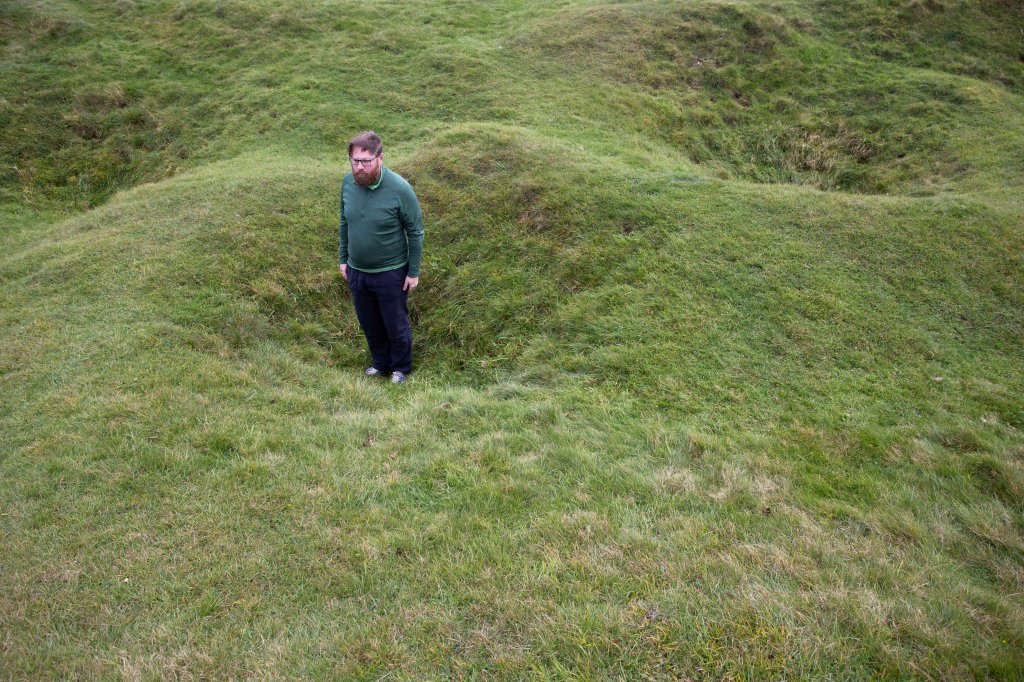
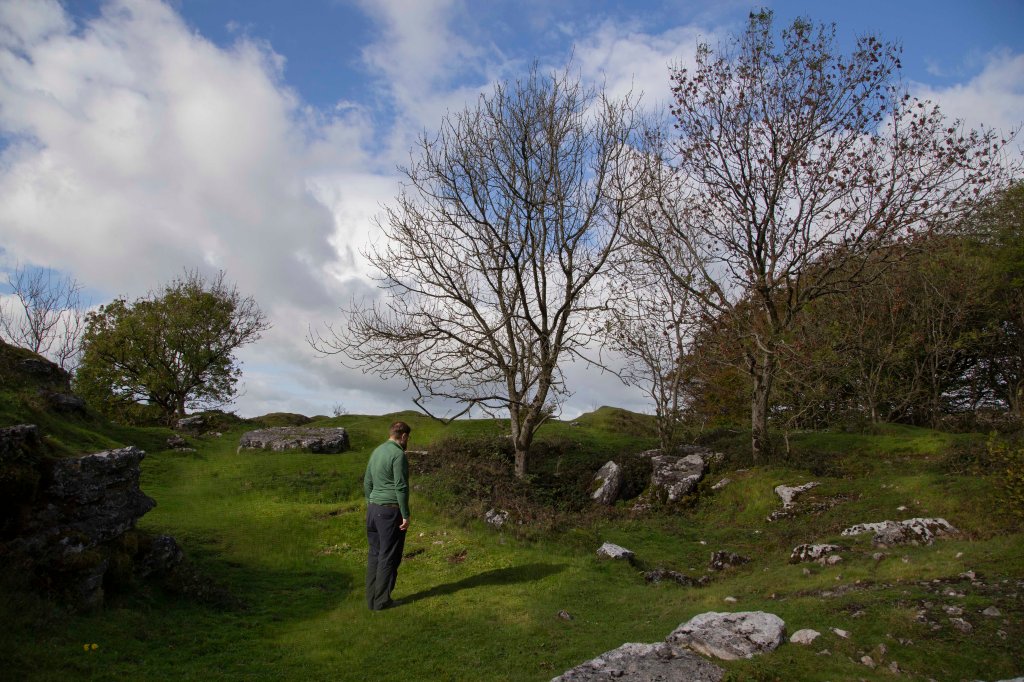
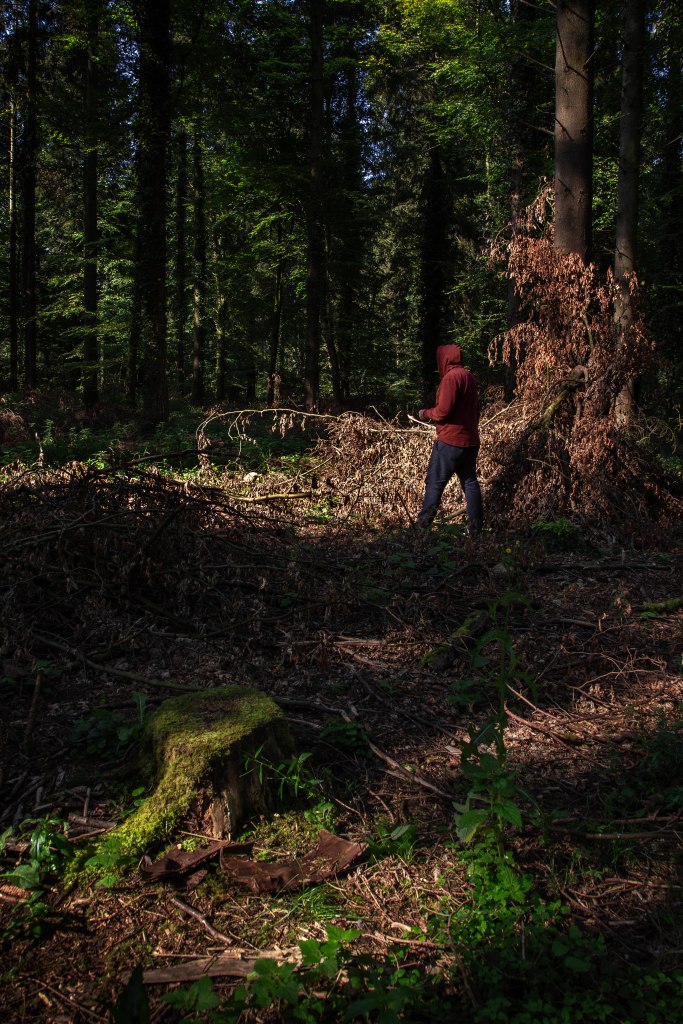
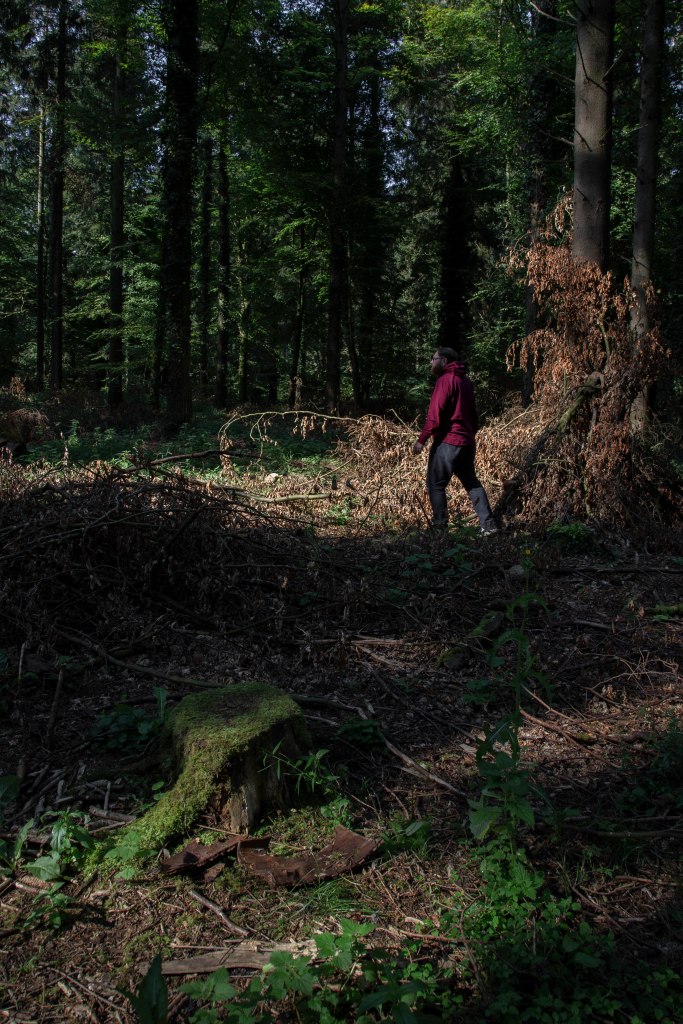
I have used the styling of Brotherus in my image ‘Big red riding hood’ as a method of linking space with a more subconscious context. When we are children we are told stories such as Little Red Riding Hood as ways in which to warm of the dangers of the woods or forest. However still wanted to keep some ambiguity in the context of theses images, allowing the viewer to question the context further.


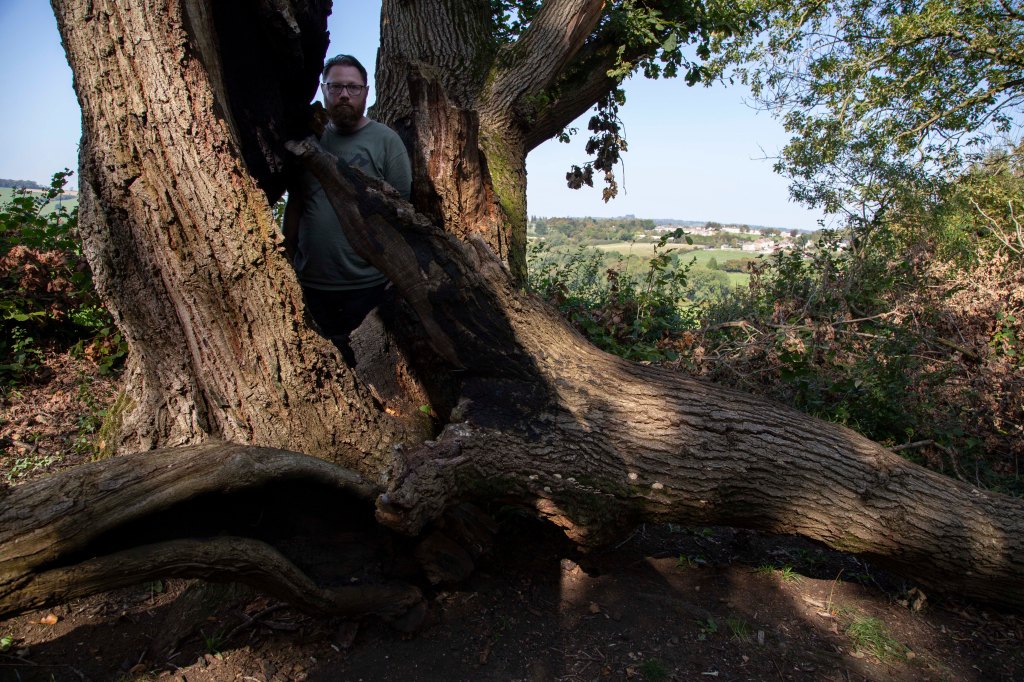
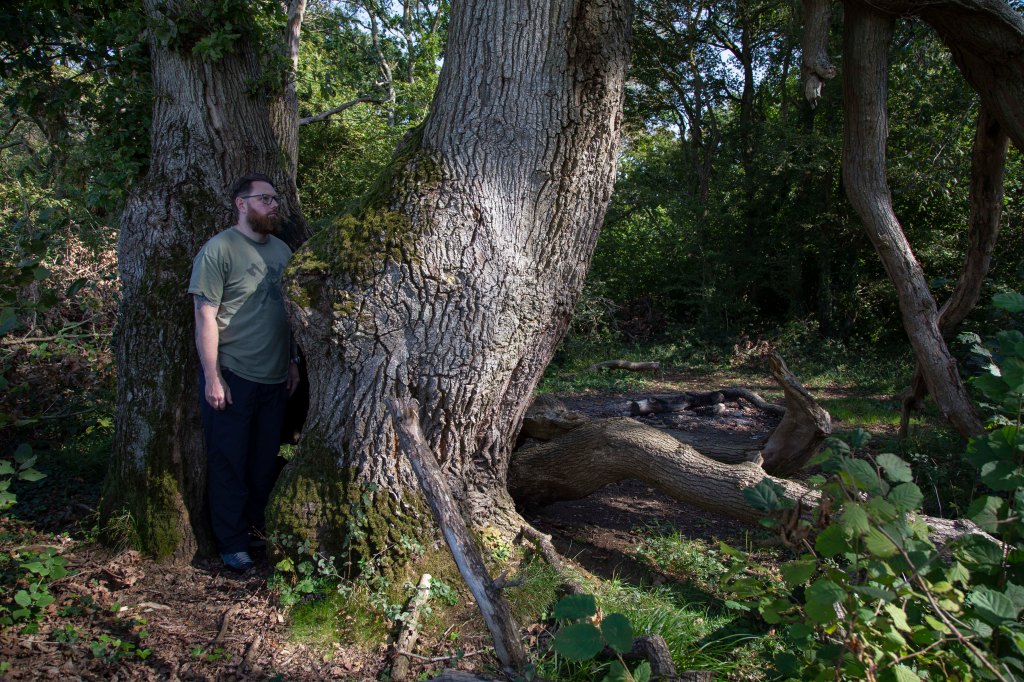
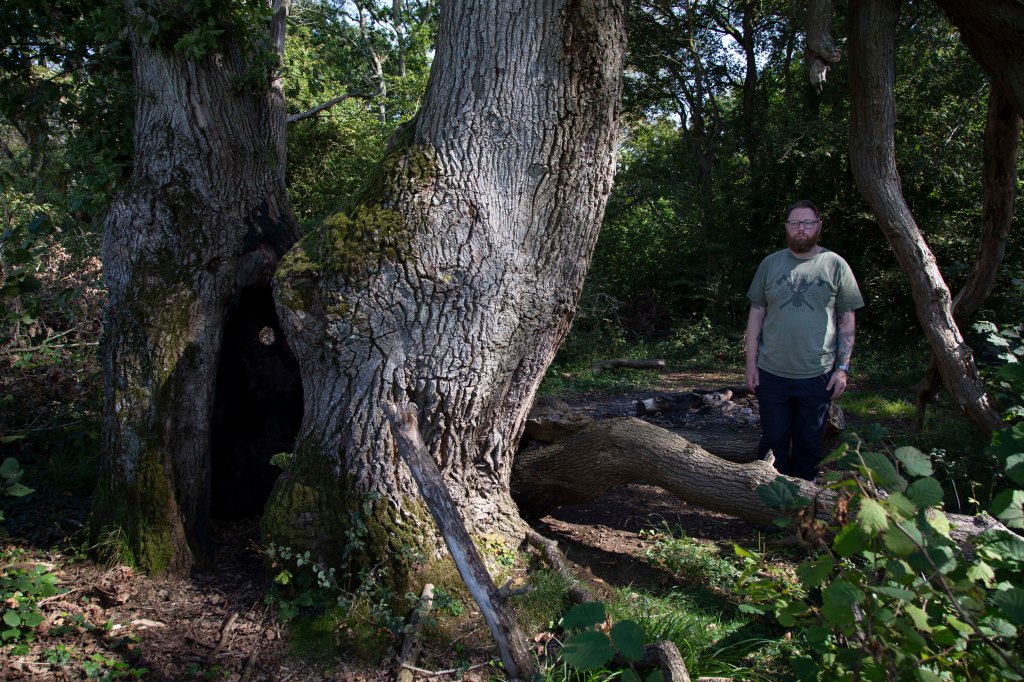
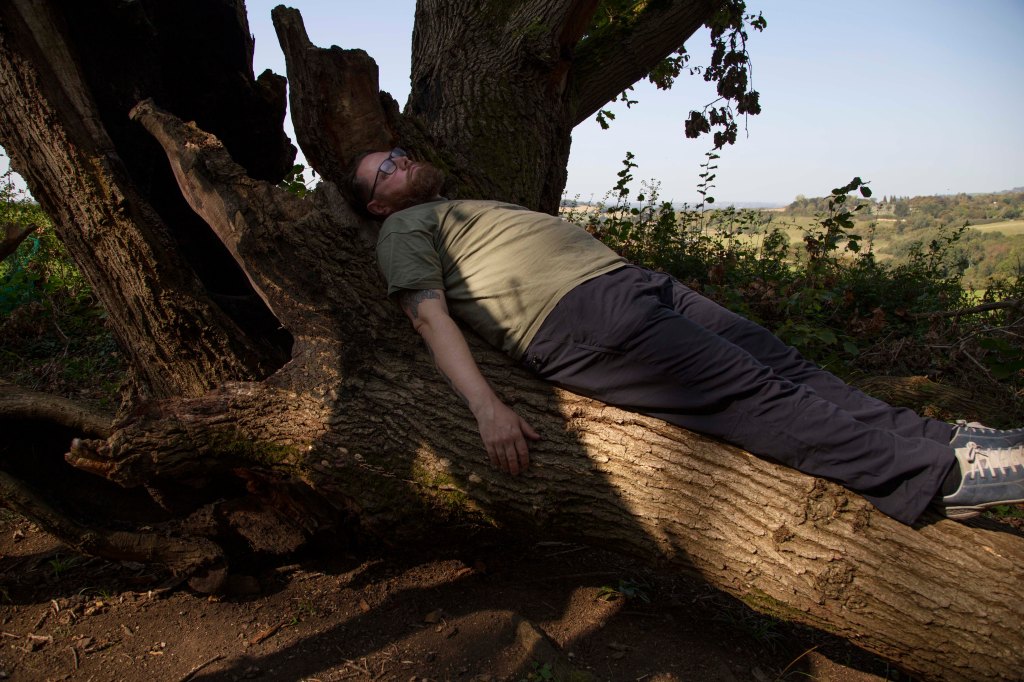
 The Space Between