When considering the various characteristics within photography and in particular my own practice. It becomes clear that I adopt a few distinct characteristics when approaching an idea or out shooting and these characteristics drive my own human choices.
The Frame
When considering the idea of an image I will first consider what will fill the frame, not unlike a blank page ready to be written upon. Then I consider what will be outside the frame, what will the view not see, what will they fill in by using their imagination. These two factors are key before even picking up the camera as often this will have a direct bearing on the location of a shoot.
Framing a shot is then a process of working with the environment and the subject. For example, in this image of vernacular garages, the key was to work with the background to juxtapose the garages against the view of the Royal Crescent and Bath countryside. As such we see the use of vantage point to achieve this result.
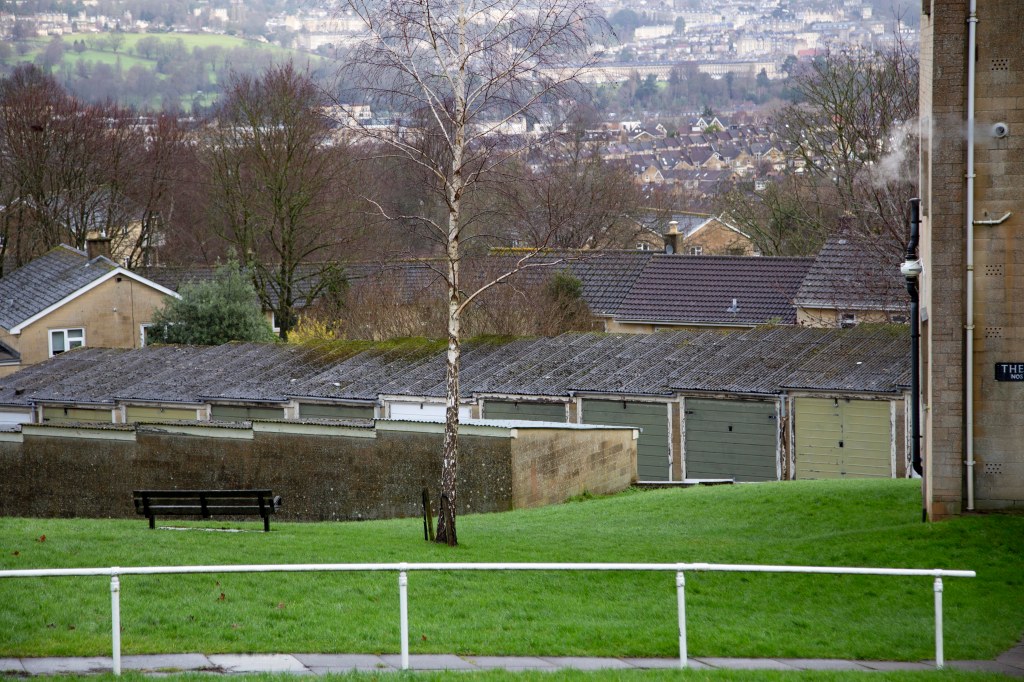
“The central act of photography, the act of choose and eliminating, forces a concentration on the picture edge- the line that separates in from out-and on the shapes that are created by it” [Szarkowski 1966:9]
“The Frame ‘isolates’ unexpected juxtapositions, creates relationships between ‘facts’ that have been framed, cuts through familiar forms revealing unusual fragments”. [Szarkowski 1966:70]
Focus
I tend to spend time walking without a camera, a kind of psychogeographic exercise in mentally mapping a woodland, city or suburb. Often noting the areas that will work best during particular lighting, time of year, time of day/night or weather.
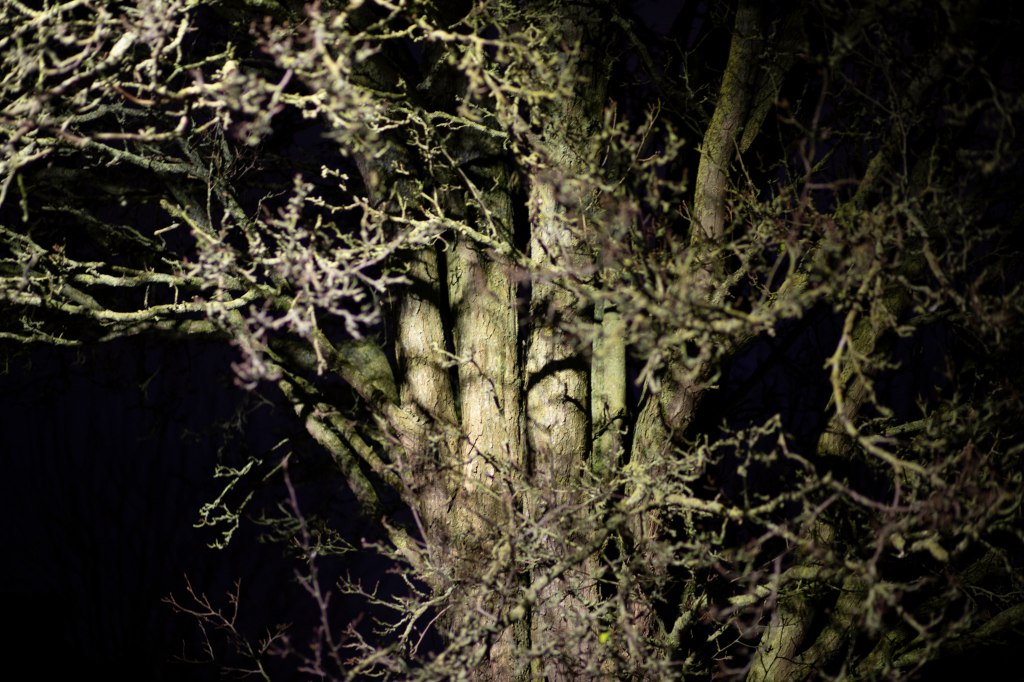
By focus I refer to both the focus of attention (the subject) and focus in a more mechanical sense. Once a shot is in the frame and at the right vantage point, my next consideration is the focus. How to best achieve the impact I desire, what will the viewer need to see and how will they see it, are all questions I have in mind whilst working. There are the obvious traditional methods of setting up a shot using the rile of thirds, depth of field and point of focus. But often it is when choosing to go against this tradition you can unsettle the view, who is conditioned to see in this way. Something akin (for westerners) righting right to left, the reader will still be able to read the text but will have to retrain their brain to do so.
As with Todd Hido’s images shot through ‘rain’ covered car windows, the focus is ephemeral, on the idea of the thing rather than the thing itself.
“Most importantly, I really love dramatic weather. I enjoy outings in those conditions. I feel so good when I’m driving, poking around for pictures, and it’s raining or snowing outside…. Diffused light is has always been the kind of light I’m after. I’m also drawn to backlit scenes, and I often like to shoot straight into the light. Shooting through a foggy dirty, or wet windshield really helps cut the brightness. It also makes for a painterly image.” [Hido 2004:online]
“it’s not just a photograph of the landscape but it is a photograph from my personal perspective. I’m somehow in the picture in a way. That is my breath fogging up the window! It has more of an intimacy I think. It has a subjective, diaristic quality and now that I really think about it—it’s the opposite of something like an ‘authorless’ objective view, which is most often seen from a higher, uncommon viewpoint.” [Hido 2012:online]
“Hido keeps at least three water bottles with him in his car. One time, I watch him spray his windshield before taking a landscape photograph. ‘I’ve learned from sheer disappointment that sometimes I need to take pictures, but it isn’t raining outside,’ he says.
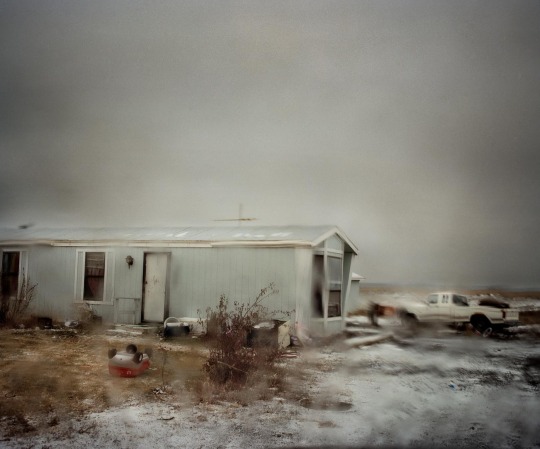
Sometimes the artist sprays glycerin on the windshield, for a different kind of effect. It’s a technique he compares to changing paintbrushes. The size, direction and position of drops of water on the car window inform the photograph that results, and within these fictitious raindrops, Hido says he can ‘compose’ the real picture that he wants to see. Ultimately, each photograph is a composition. It is a way of giving shape to a mental state, as opposed to capturing an actual setting.” [Tylevich.K undated:online]
The use of focus/unfocus within an image as in Fig.2 are like our memories, sometimes hazy or unclear and other times pin sharp and crystal clear. This is something that Hido manages to capture with his ‘Roaming’ images, landscapes both in and out off focus.
One of the final considerations is the end result, who the audience is and how the final images will be viewed. This to me have been something of a new choice, having only exhibited in joint exhibitions and one small solo exhibition, my experience is limited. However, in my current practice I have begun to these make choices. If we look to fig 1 again, for the viewer to understand the image they need to see the juxtaposition between the mid ground (garages) and background (landscape) as such the final print will need to be large, perhaps 160x100cm or larger. As my practice and personal project develop so too will the choices I make.
References
Hidio.T ‘Roaming’ Interview with Shuman.A, 2004, SeeSaw Magazine. [Accessed 01.02.2021] http://www.aaronschuman.com/roaming_pages/roaming_interview.html
Hido.T Rose Gallery interview with Augschoell.D and Jasbar.J, 2012, ahorn magazine. [Accessed 01.02.2021] http://www.rosegallery.net/blogarchive/2012/06/29/interview-with-todd-hido
Tylevich.K ‘Roaming’ text from the Todd Hido website [accessed 01.02.2021] http://www.toddhido.com/roaming.html
Szarkowski.J 1966. The Photographer’s eye. London: Secker & Warburg
Images
Fig.1 Beale.T ‘Untitled’ 2021
Fig.2 Beale.T ‘Untitled’ 2021
Fig.3 Hido.T ‘Roaming: #9197’, 2010. [Accessed 01.02.2021] http://www.toddhido.com/landscapes.html
 The Space Between