Three by five, three by four, three by two, five by six, these are but a few of the grid like combinations of images presented in the body of work called “Typologies” by Bernd & Hilla Beche that spans some four decades. Documenting the structures that sit within an industrial landscape like monolithic sculptures, the Becher’s ability to remove the often overlooked from its setting and place it down onto paper is in itself a work of art.
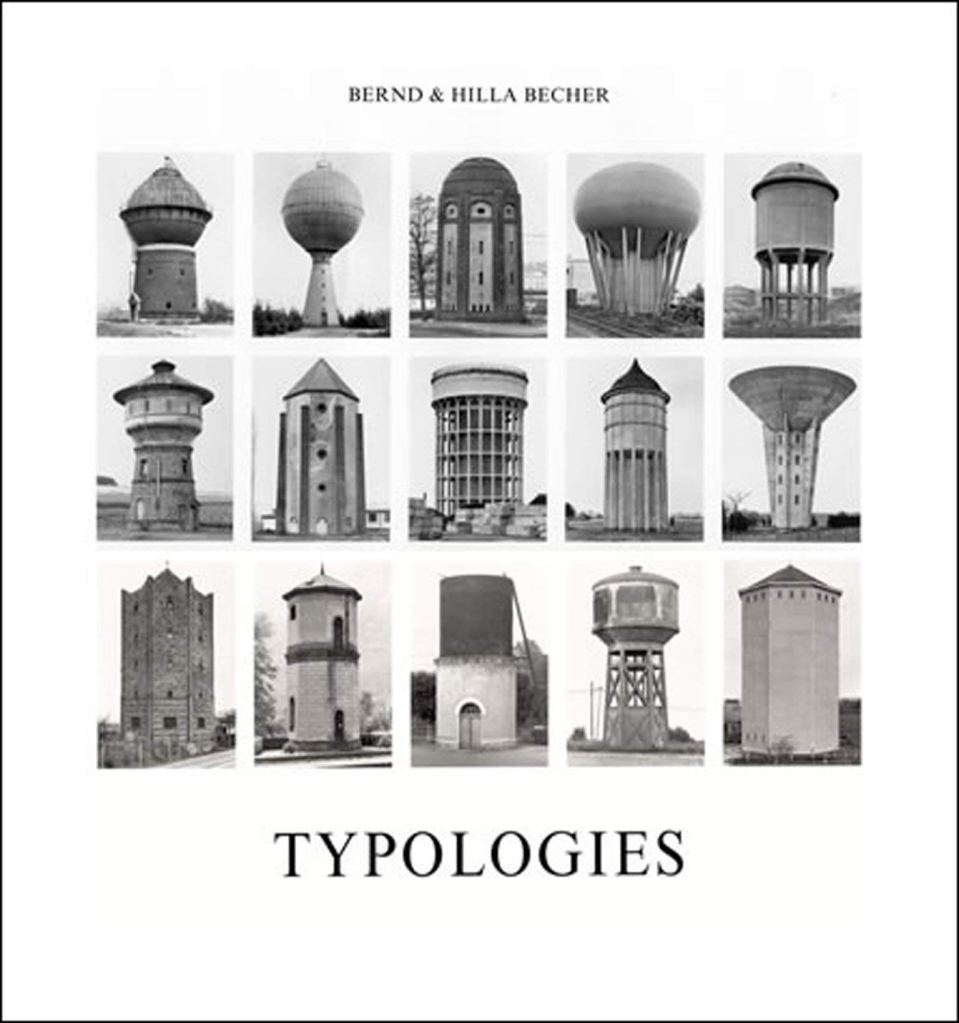
“The Becher’s technical rigor is also exemplary, the strength of their work owing to their consistency of framing and evenness of the light on their subjects. The simplicity of their practical approach-and that of the other photographers from the ’New topographies’ exhibition-has endured within landscape practice as well as within other spheres of contemporary photography.”[Alexander 128:2015]
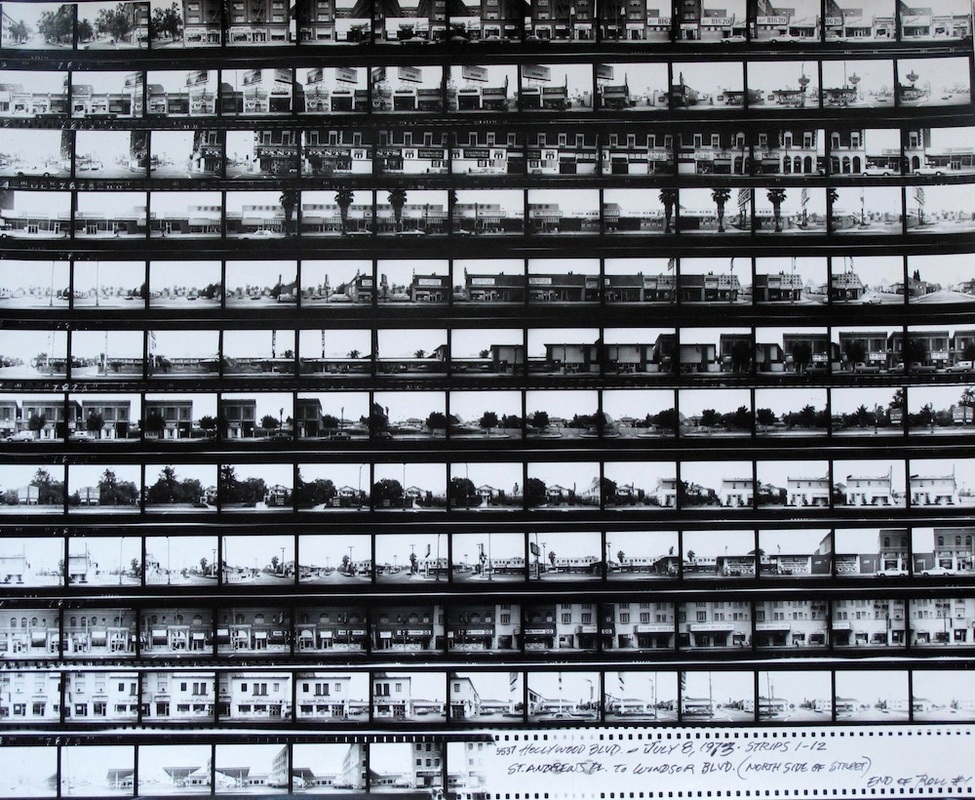
The concept of typologies within the medium of photography is not a new one, but is one that has been used to great effect especially when looking at the work of the likes of Ed Ruscha. Ruscha uses the everyday, mundane and bland within bodies of work such as ‘Every building on the sunset strip’ as a method to create flow and a sense of movement as the viewer is transported along the strip, move from image to image as one would drive from building to building. However the way in which the Becher’s deliver their images is much more static, rigidly controlled, placed into grids, edited to emphasis the familiar, whilst allowing the viewer to consider the contrasts between each structure.
“After all, Bernd and Hilla Becher are not interested in the individual photo, but above all in what their way of seeing, restrictively defined in its way, actually makes possible, namely a comparison of appliance-like structures of a particular type, such as gasometer , halls and silos.” [Zweite in Becher 15:2014]
It is not only the finished image that is controlled so to are the subjects, not so much the staging or composing of each structure but rather the construction. Each photograph is meticulously planned, the time of day, weather conditions, elevation of camera, and position of structure within the frame.
“We precisely did not show pictures that we had composed but instead images that were already composed. We simply selected objects that could be captured and were thus there for the taking.” [Becher 7:2014]
Discussing the “New Topographic: Photographs of a Man-Altered Landscape” (1975) exhibition, which featured Bernd and Hilla Becher’s ‘Topologies’, Jesse Alexander states:
“Just as the subject matter in the photographs was commonly considered mundane or bland, the visual qualities of the photographs were simple and unembellished and were met by traditionalists with skepticism and perplexity.” [Alexander 127:2015]
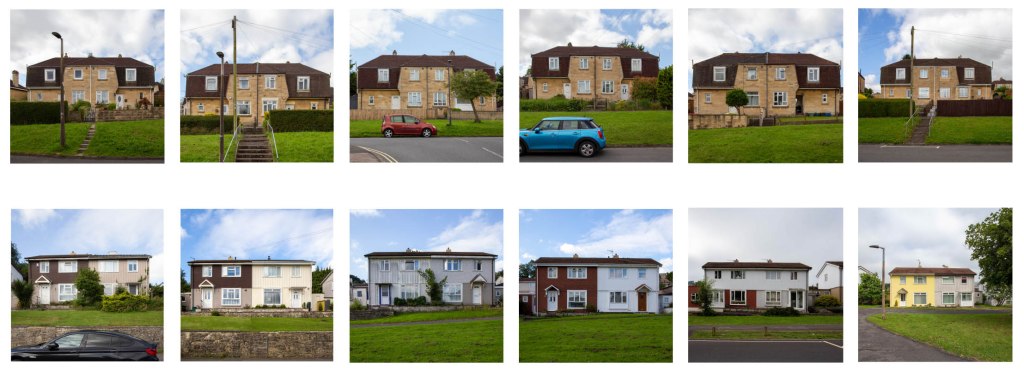
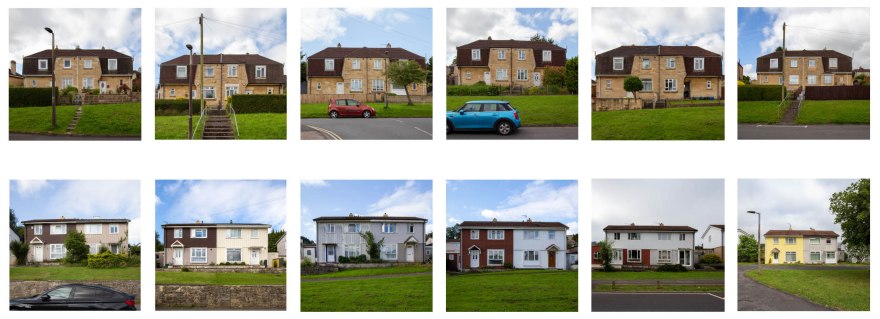
Within my own practice the use of typologies has been a useful tool to illustrate the uniformity of publicly funded social housing of the 1930s and 40s. To ensure each image created, for the topology series, had a uniform appearance I had to set several control factors. Each image needed to be taken during the same weather conditions, framed within the same space, and using the same camera setting such as f stop and aperture. This was particularly challenging give Bath’s topography, being built in a valley, many of its houses are built running along steep hills. Shooting straight on with a wide-angle lens gave me the best option to create uniformity with each photograph. The use of repeated images of mundane dwellings worked well for the series of early social housing but less so for more contemporary housing stock. As such, I chose to only adopt this method for a few typologies through the book “The right to this city”.
References
Alexander, Jesse “Perspectives on place: Theory and practice in landscape photography” 2015 Bloomsbury
Becher, Bernd & Hilla “Typologies” introduction by Armin Zweite 2014 edition MIT Press
https://www.photopedagogy.com/typologies.html [Accessed 30.10.2021]
Images
Figure 1 Becher, Bernd & Hilla “Typologies”
Figure 2 Ruscha, Ed “Every building on the Sunset Strip” 1965
Figure 3 Beale, Tim “The right to this city” 2021
 The Space Between