When considering what is ‘appropriate’ to photograph or look at we are confronted with a moral question of is it ‘right’ or ‘wrong.’ Within my own practice I have found myself making this moralistic judgement when choosing what to photograph. on a recent night-time walk I happened upon a scene that I thought would be a great picture. It was the view from the street into a front room, via a window with curtains open, a female figure was sat, glass of wine in hand, watching TV. The lighting was great, and I knew it would work well. I chose not to take the shot, not from a legal stance but from a) fear of what people may think if seen photographing into people’s home and b) I felt this to be an intrusion. Feeling I needed to challenge my own ‘moral code’ I set about capturing images that I felt pushed against my own anxieties. The images have a voyeuristic quality, a mix between CCTV and the paparazzi. [Images 1-3].
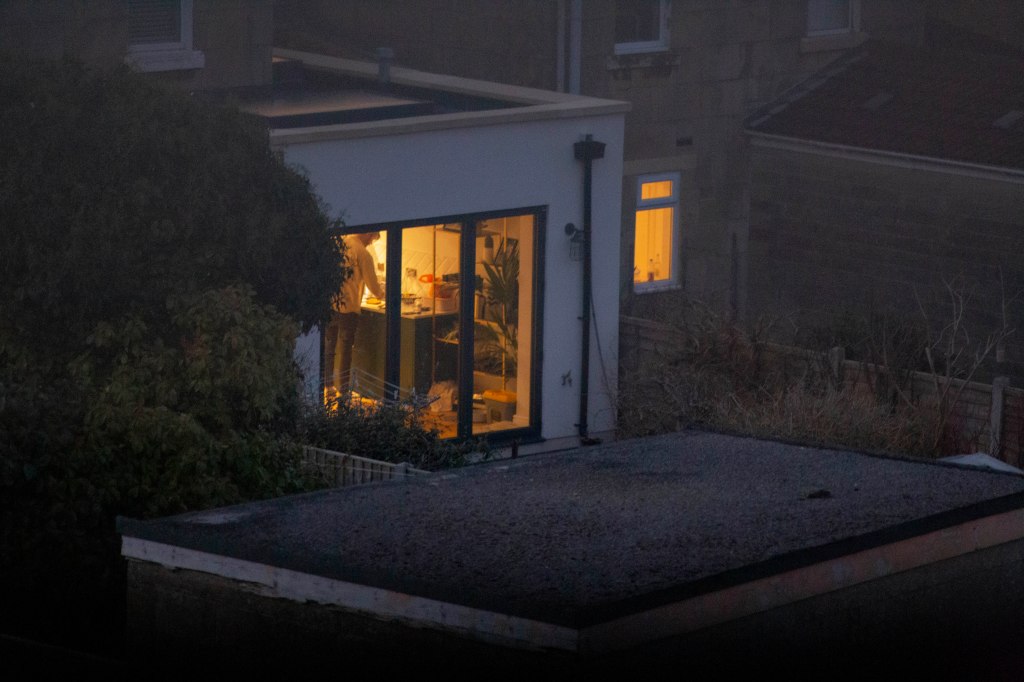
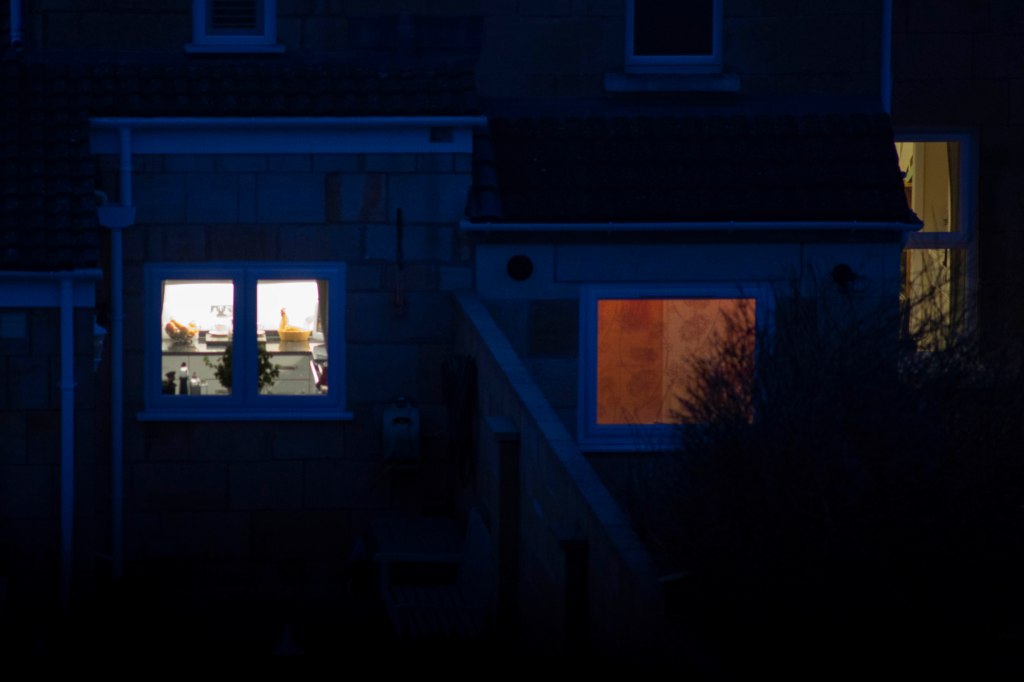
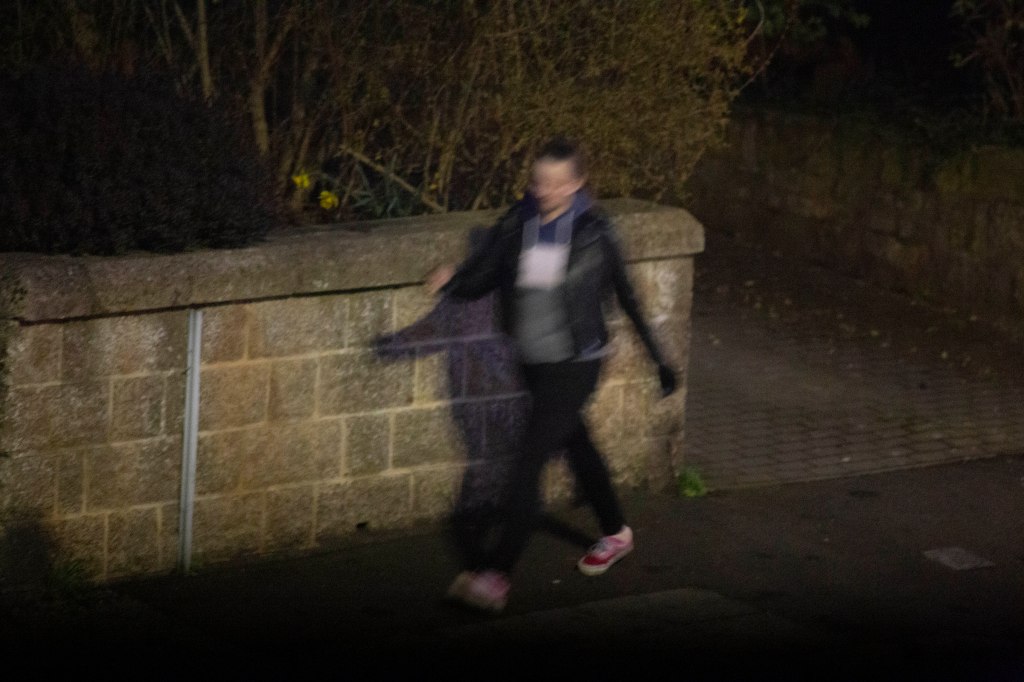
The subject of the gaze can be looked as one in terms of a moralistic questioning; from the images such as those of Diane Arbus, of marginalised people, to the male privileged gaze and images of Helmut Newton. Both photographers claimed to empower their subjects, however equally both have been criticised for creating exploitative images. Susan Sontag said of Arbus’s work:
“Arbus photographs people in various degrees of unconscious or unaware relation to their pain, their ugliness…Arbus wanted her subjects to be as fully conscious as possible, aware of the act in which they were participating. Instead of trying to coax her subjects into a natural or typical position, they are encouraged to be awkward-that is to pose… Most Arbus pictures have the subject looking straight at camera. This often makes them look odder, almost deranged.” [Sontag 1977:36-37]
Meanwhile, in Newton’s case, it can be argued that images of women are constructed as objects of desire for the benefit of the male gaze. Newton’s images portray the idealised woman, always young, slim and attractive, certainly not a n unbiased representation of the fatale form. A far cry from the self-proclaimed ‘feminist’, Newton claimed to be. When we question, was there a collaboration between model and photographer? Did the model choose the construction of the image? No, it is apparent that Newton’s images are his constructs, the intention may have been to place the female figure in a position of power and therefore ‘empowered’ but even a negotiated reading of Newton’s images lead back to the fetish and eroticism. [Baker 2001:online]
Sontag discusses the targeting of the male gaze by camera manufacturers, as a phallic extension not unlike a gun and further explains:
“The camera/gun does not kill, so the ominous metaphor seems to be all bluff-like a man’s fantasy of having a gun, knife, or tool between his legs…To photograph people is to violate them, by seeing them as they never see themselves, by having knowledge of them they can never have; it turns people into objects that can be symbolically possessed.” [Sontag 1977:14]
John Burger describes the gaze as such:
“Men look at women. Women watch themselves being looked at. This determines not only most relations between men and women but also the relationship of women to themselves” [Berger 1972:47]
Applying these examples to the male gaze and in turn towards Newton’s images we see that his target viewer is a far cry from the feminist and more aligned with the male privileged voyeur. As with Arbus the images of both photographers may have been read in opposition to their intention, either way the viewer has been left with the choice to look or not look.
Challenging the constructs of the male gaze are the likes of Cindy Sherman who uses the female stereotype tropes from cinema, pornography, advertising, and fashion to construct familiar looking self-portraits. These images challenge the way the viewer sees the female figure within the photograph. Charlote Cotton further states:
“The conflations of roles, with Sherman as both subject and creator, is a way of visualizing femininity that confronts some of the issues raised by images of women, such as who is being represented, and by whom is this projection of the ‘feminine’ being constructed and for whom.” [Cotton 2009:192-193]
Kourtney Roy is another photographer further explores the feminine image adopting an approach much like Sherman, as both creator and subject. In Roy’s series ‘The ideal women’ she adopts the persona of American clichéd female roles from the male dominated 1960’s, air hostess, secretary, cheer leader, beauty queen. Each image is carefully constructed from the kitsch backdrop, vintage clothing to the glamorous make up, that transforms the female figure into a mannequin. But the real power of these images come from the way in which Roy poses herself. The figure is pale and rigid with a downward gaze, looking away from the viewer, away from the male gaze (figures 4&5). In an article by the British Journal of Photography discusses Roy’s work with her:
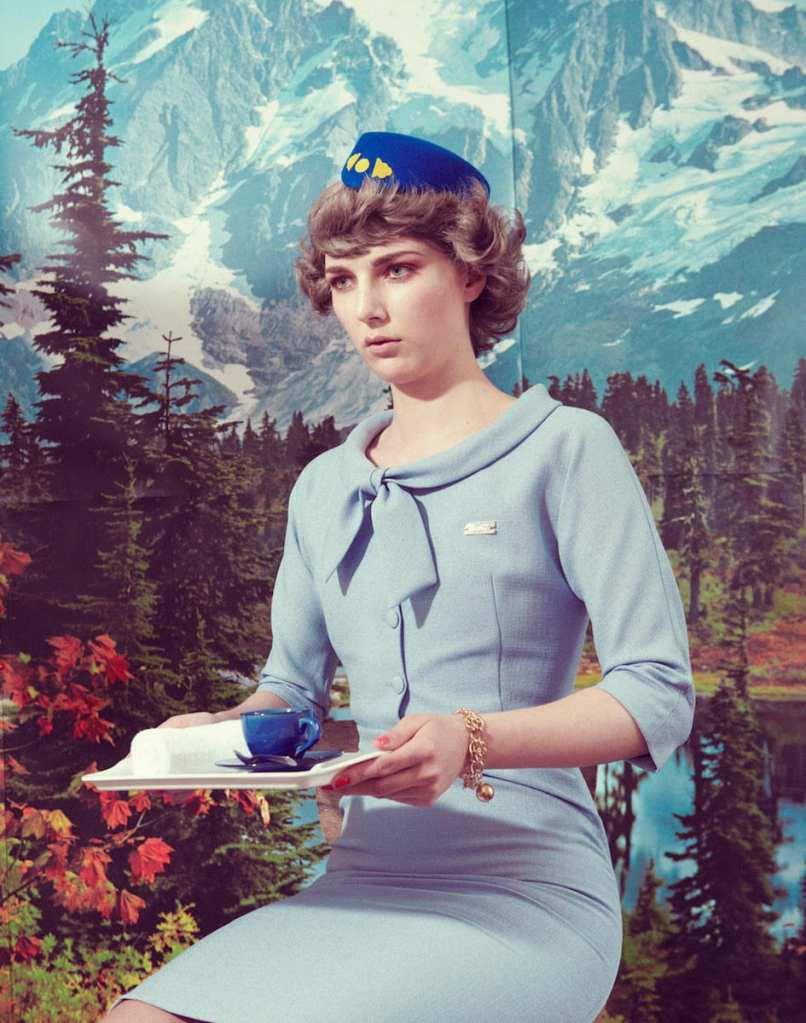
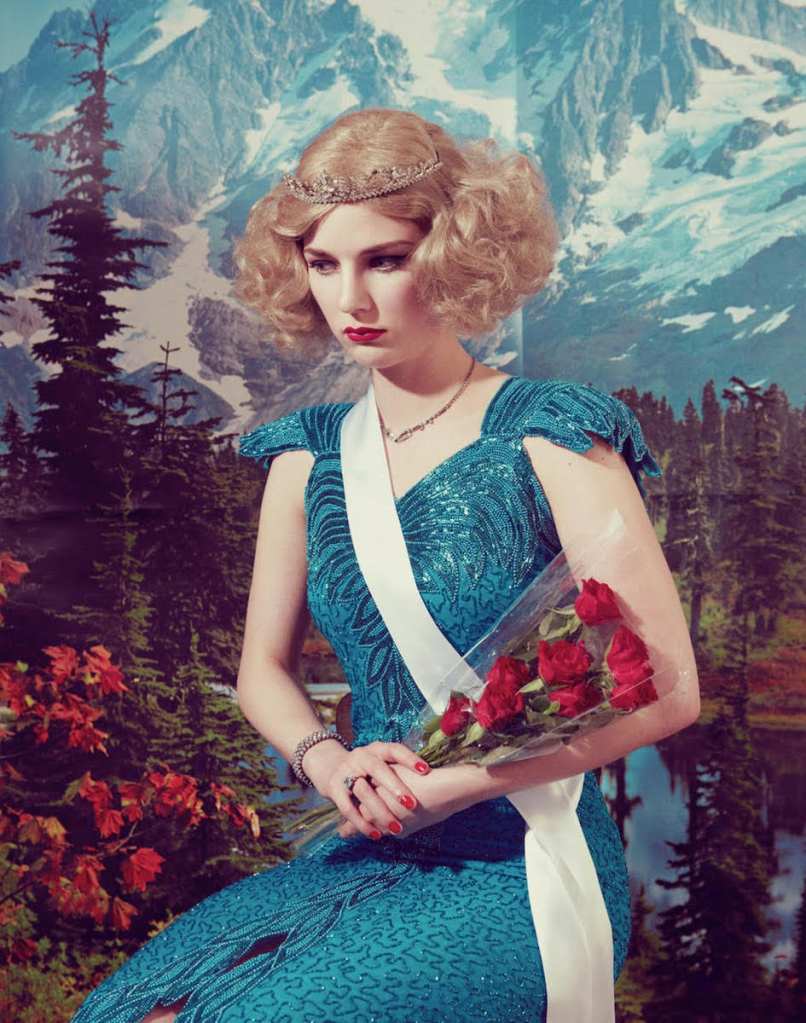
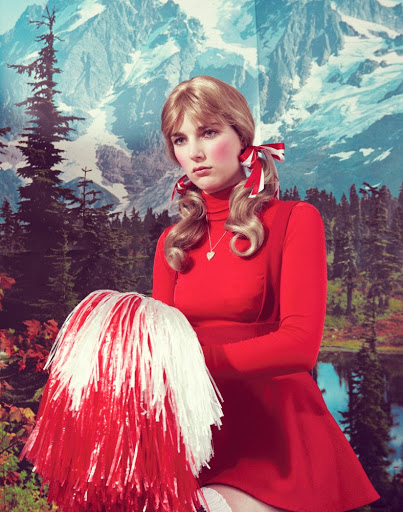
“In contrast to her use of bold aesthetics, Roy’s reference to the male gaze in the ideal woman is subtle. This reflects her understanding of gender discrimination in both the photography industry and society at large: “I think that discrimination operates in a much more subtle and pervasive manner,” she reflects. “Discriminatory behaviour has been so conditioned that we often accept it as natural, as opposed to learned behaviour.” [BJP/Roy 2019:Online]
The resulting images by Sherman and Roy, make for uncomfortable viewing, seeing the figure in a position of melancholy, regret or depression. Far from Helmut Newton’s so called empowered images of powerful women. I find myself asking; What does this mean for the male gaze and in particular my practice? How can I challenge male privilege within my own practice? But also, am I, from my position as the male privileged, right to attempt to do so or should this be best left to those who suffer from it?
References
Baker. L (2001) Helmut Newton: a perverse romantic https://www.theguardian.com/lifeandstyle/2001/may/05/weekend.lindsaybaker [accessed 02.03.21]
Berger. J (1972) Ways of seeing. Penguin
Cotton.C (2009) The photograph as contemporary art. Thames & Hudson
Sontag.S (1977) On Photography. Penguin
BJP (2019) Female in Focus: Kourtney Roy deconstructs the male gaze. British Journal of Photography 1854 media. https://www.1854.photography/2019/03/female-in-focus-kourtney-roy-deconstructs-the-male-gaze/ [accessed 03.3.2021]
Images
Figures 1-3 Tim Beale 2021
Figures 4-6 Kourtney Roy ‘The Ideal Woman’ series. http://www.kourtneyroy.com/?do=gallery&gallery=ideal_woman#ad-image-0 [Accessed 03.03.2021]
 The Space Between