The photograph has often been described as a nonverbal form of communication and as such can be read by way of semiotics, the understanding of symbols and meanings with an image. The photograph is unique in the way in which it is viewed in many ways, on one hand it is a representation of a ‘thing’ in that instant, in that location and under those conditions. It can also be viewed reading or looking out for signs and messages within the image but also the viewer is invited to look beyond the frame. Victor Burgin, in his essay “Looking at photographs”, writes about the ‘photographic text’:
“Photographs are texts inscribed in terms of what we may call ‘photographic discourse’, but this discourse, like any other, engages discourses beyond itself, the ‘photographic text’, like any other, is the site of a complex ‘intertextuality’, an overlapping series of previous texts ‘taken for granted’ at a particular cultural and historical conjuncture.” [Burgin 1967:131]
One of the ways to see this ‘photographic text’ or communications, is to look at the advertising image. The advertising world has for many decades researched the needs and desires of the viewer as can be seen in both moving and still images. Since the 1950’s anthropologists, sociologists and psychologists have questioned and observed human buying habits in an attempt to better understand what drives our choices. Advertising is based on knowledge of human learned behaviour, makes assumptions that we will ‘know’ that this ‘thing’ means this ‘symbol or action’ – anthropological knowledge.
“The task now is thus to reconsider each type of message so as to explore it in its generality, without losing sight of our aim of under standing the overall structure of the image, the final inter-relationship of the three messages.” [Barthes 1977:p36] “Today, at the level of mass communications, it appears that the linguistic message is indeed present in every image: as title, caption, accompanying press article, film dialogue, comic strip balloon.” [Barthes 1977:p37]
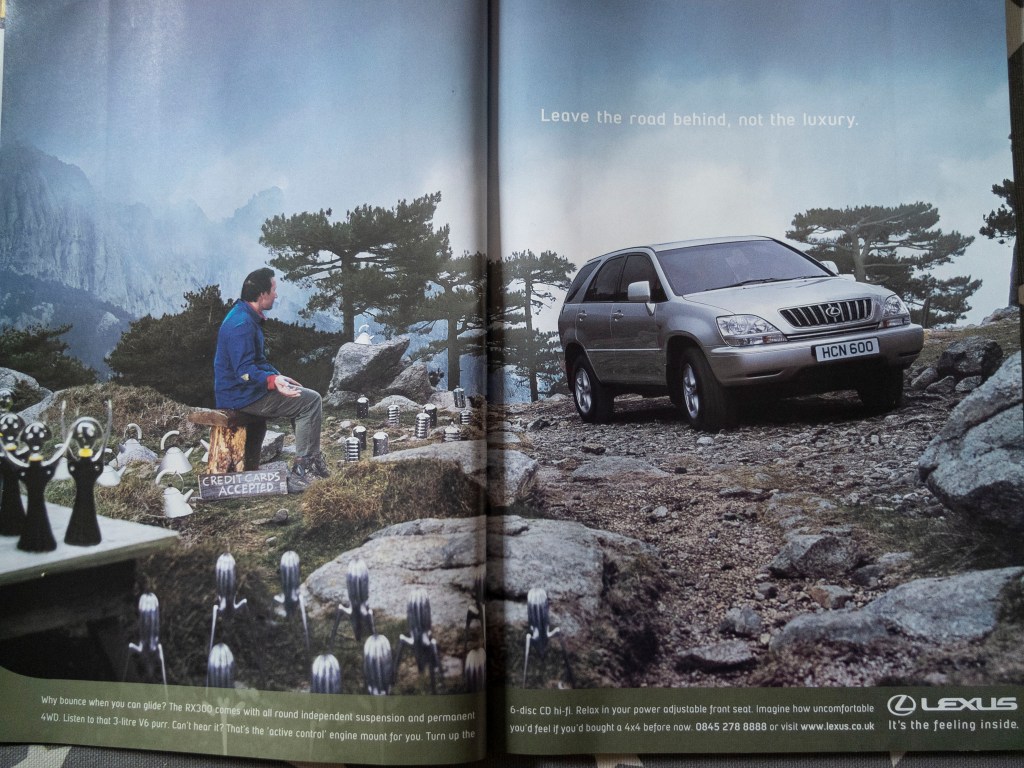
If we look to this advertisement for Lexus RX300, we can see that the advertisers are appealing to a luxury market and those with aspirations of design and taste. The image signifies the driver having assented a mountain, traversed rugged terrain to shop for luxury designer goods. The text further acts as anchorage, telling us the 4-wheel drive delivers a smooth drive without all the usual bumps and bounces associated with 4WD vehicles. We can also learn that the target audience is potentially female via the use of Allesi designer kitchen goods within the image appealing to the stereo type of the house wife out shopping for luxury items.
We can read images, especially advertising images, in three ways; ‘Dominant’ – reading the image as the photographer intends, ‘Oppositional’ – not seeing what the intentions is or interpreting the image in a different way to the intention, and ‘Negotiated’ – reading the intended meaning of and image but also seeing a new meaning. Often images in isolation can produce one meaning but when paired or placed within a series of images, takes on a new meaning all together. An example of this can be seen in these images (figs x -x) that were discussed at a recent tutorial. In isolation the image of the left toy bear initially elicited a reading of ‘lost child hood’ or ‘play’, as did the image of the rope swing which offered a similar reading by my peers.
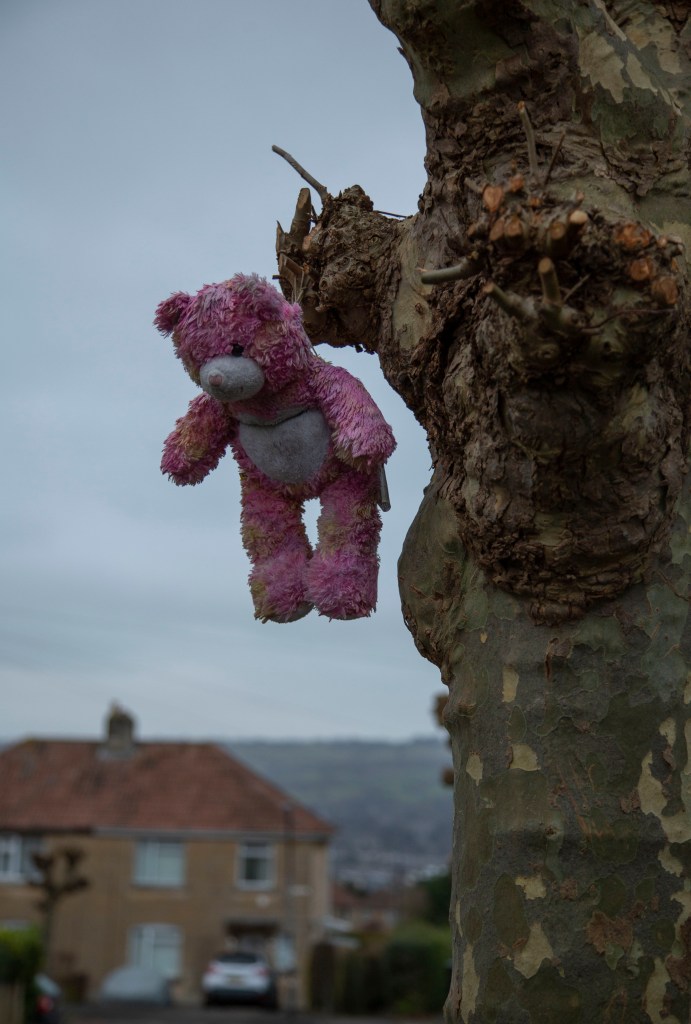

However, when places side by side the reading of these paired images was one of a more sinister nature, much darker than the melancholy of the individual images. The bear looks all the more ‘Strung Up’ and rope swing becomes a ‘Hang man’s noose’. These readings are Oppositional to my intent when capturing these images, my initial intent was to illustrate the ‘Lost play’ lockdown has produced.
References:
Burgin, V 1967 “Looking at Photographs in “the photography reader” Wells, L. 2003, Routledge.
Barthes, R 1977 “Rhetoric of the Image” Image-Music-Text, London:Fontana
Images
Figure 1 Lexus RX300 Advert from National Geographic magazine July 2001
Figures 2-4 Tim Beale 2021
 The Space Between