Two artist photographers that I have found who step beyond the stereo typical white cube format of a photography exhibition have been Carter Mull and Shirana Shahbazi. Both photo artists utilise the space they display their work in, manipulate or incorporate the space as to become part of the exhibition.
Carter Mull, an American artist uses photography and re-photography in his practice is a visual metaphor that conveys the density of communication saturation:
“The meaning of making and watching images in a world in which visual bombardment is omnipresent to the point of over saturation.”
Mull’s work often uses archival materials from old newspapers, a media that he describes as being almost obsolete, the daily paper would be regarded as history each day. By re-photographing and using these newspapers in his work Mull is creating new histories. Building up collages and photographs of multiple sources he creates something new. For me these individual works only really come into their own when exhibited and a single unit. As with the 2006 ‘Ground’ and 2010 ‘Metemetrica’ exhibitions, Mull uses 1800 offset prints on various media strewn about the main exhibition space floor for visitors to walk on. The number of prints corresponds to the number of individual frames in sixty seconds of video footage, at the standard rate of thirty frames per second. I feel this density of images further bombards the viewer and instils the context in Mull’s practice.
“I also want this same logic to function between photographs. This is why I try to emphasise the diversity of formats within my larger practice. Part of the impulse to look at the local paper also has to do with a desire to locate an image matrix— one that was delivered to me, and that houses mass images designed to cut across multiple demographics. I wanted to take the paper as a kind of generative source to structure the grammar of a body of work.”
Whilst Mull’s images seem at a polar opposite to my practice, I feel his use of space, when exhibiting, aligns to the context of my work, in that we are both using personal space (proximics) as a way to engage the viewer beyond the fixed image.
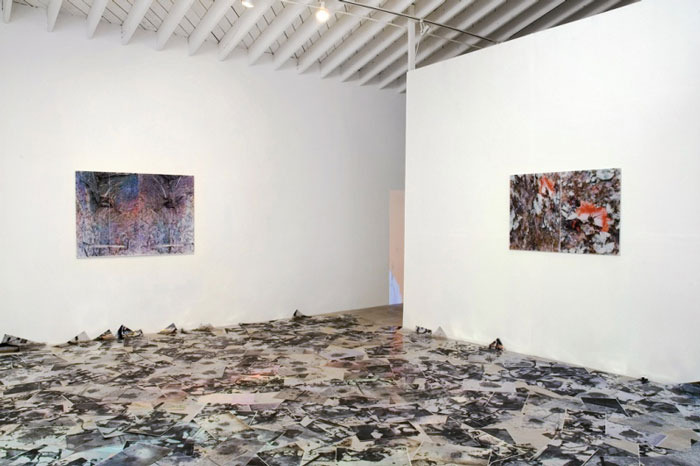
Carter Mull, ground, 2006, office jet prints, galaxy holographic film, aerosol paint unique photographs, uniquely painted, dispersed from an archive of 1800 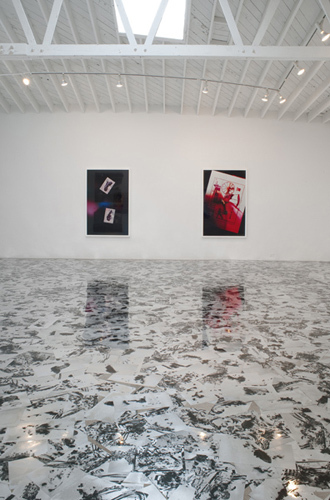
View of “Metemetrica,” 2010. Floor: Diamond, Caviar, 2010; From left: Touch, 2010; Carbon, 2010.
Shirana Shahbazi, is an Iranian-born photographer, famed for her contemporary take on traditional photography genres such as still life, landscape and portraiture. Unlike Mull, Shahbazi’s practice can often be seen as individual works with their individual contexts. Shahbazi’s series ‘Objects in mirror are closer than they appear’ 2018 she composed abstract photographical images of spaces that are distinguished by vibrant colours, juxtaposed by sharp black and white contrasts.
In the exhibition at the Kunsthaus Hamburg, Shahbazi is focused on the subject of space, both as an abstract construct and in the sense of lived urbanity. Shahbazi transformed the gallery space by means of colour and geometric shape. This use of shape and colour complements each set of images, linking in the contrasting b&w images with colour an as such unifying to create a cohesive exhibition.
What I have taken from looking at these photographers is how each has approached the design of each exhibition is another step in the image making process. An exhibition in itself should be considered the final image in a series.
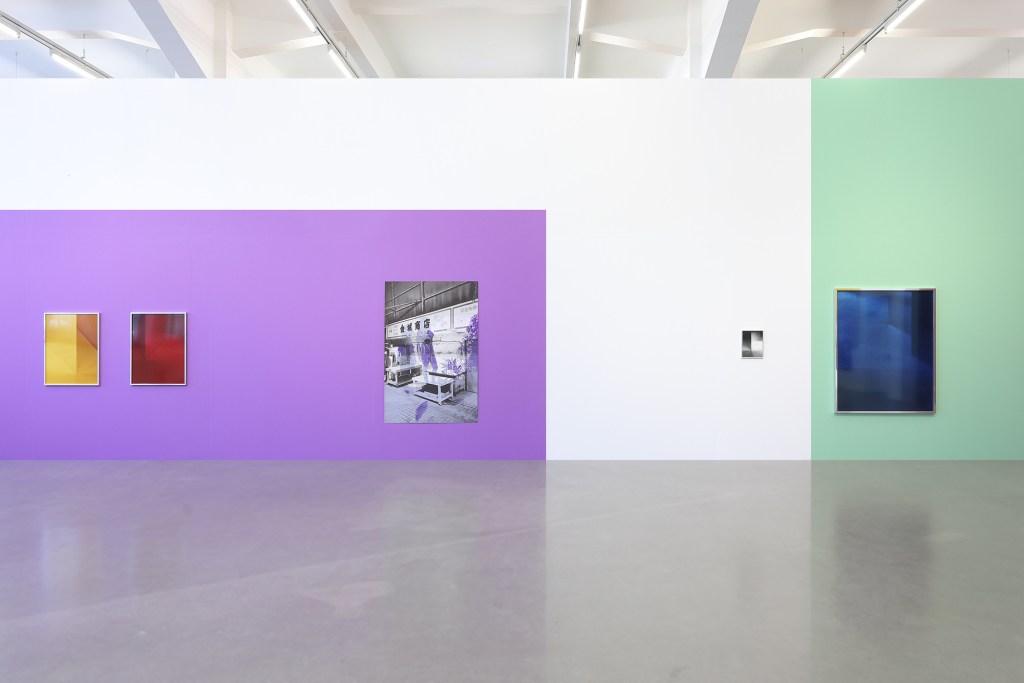
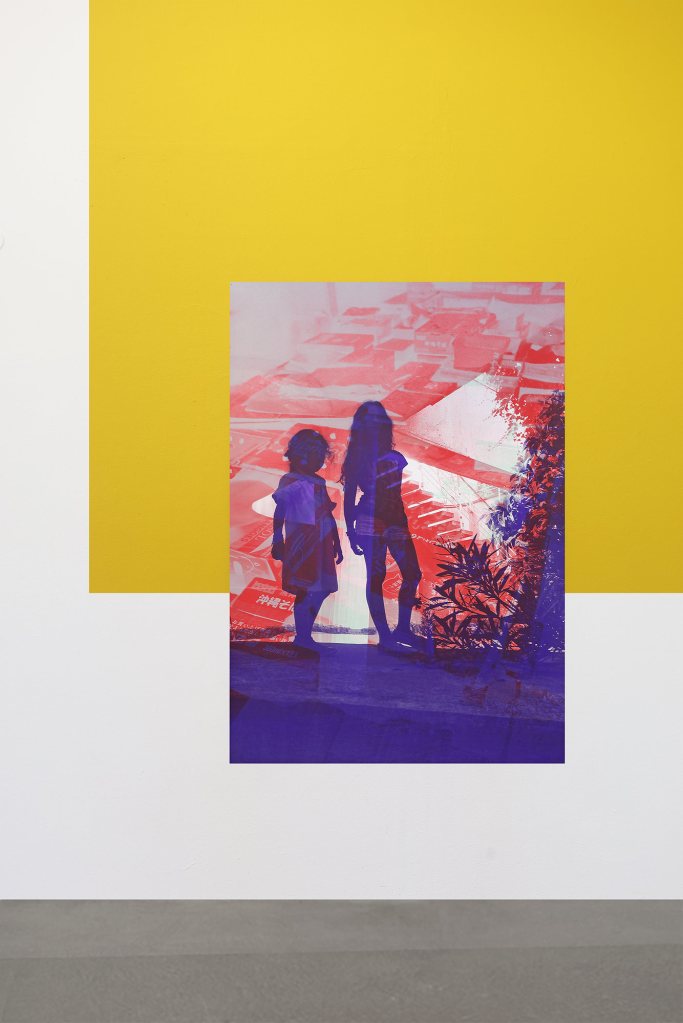
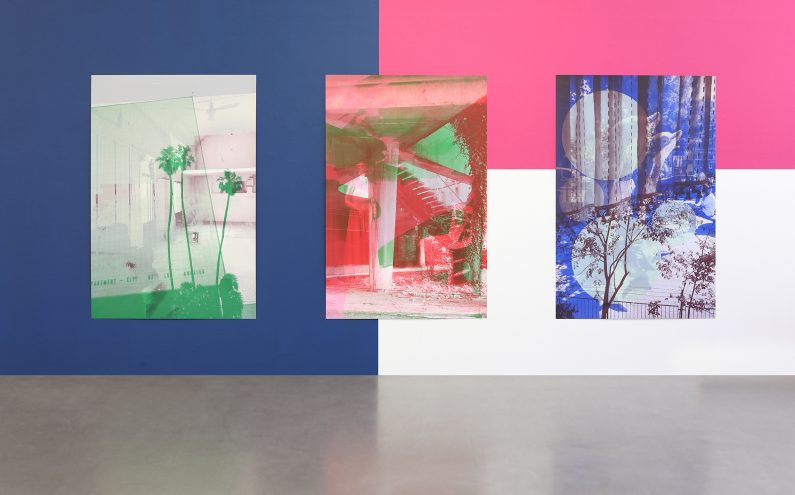
COURTESY KUNSTHAUS HAMBURG
[ Carter Mull sources: museonagazine.com interview with Richard Turnbaull 2010, Artforum: Carter Mull ‘Metemetrica’ 2010 by Aram Moshayed. http://www.museomagazine.com/CARTER-MULL]
[ShiranShahbazi sources: https://youtu.be/XsaHyQjS_rk https://www.e-flux.com/announcements/190663/shirana-shahbaziobjects-in-mirror-are-closer-than-they-appear/ https://www.moma.org/interactives/exhibitions/2012/newphotography/shirana-shahbazi/]
 The Space Between