The concept of using another’s work, photographic or other, seemed quite alien to be and not something I would have considered in my practice. However this thought process has been challenged by this week’s this topic. Looking at the controversy surrounding the work of Joy Garnett, in particular her painting the ‘Molotov Man’. Garnett’s painting’s typically use source material found on the internet, i.e. photos by others. These found images are then recreated in painted form, as with the ‘ Molotov man’. Garnett appropriated the photograph, originally taken by Susan Meiselas. The use of Meiselas’ photo without permission sparked controversy, creating what was to be nicknamed ‘Joywar’.
https://www.wikiwand.com/en/Molotov_Man
Whilst I would admit that once images are made available in the public domain, there is very little anyone can do to police the appropriation of them. Unless of course you are linked to a large establishment such as Magnum. However I do find myself siding with Meiselas, in this case because of the context of the image. It would have been clear to Garnett that the image of the ‘Molotov Man’ had been taken with the context of violent turmoil and any use of it would be to alter the context. For me it is more about my personal ethics and how I feel about using others work or the use of my work. Whilst I would welcome the use of my work I would, ideally, like to ensure either, the original context is respected or that my work plays only a part of a larger work. Of course all this is only possible through discourse between myself and the intended user.
We were also introduced to the concept of remixing work and the work of the artists and photographers such as; Candice Breitz, Robert Rauschenberg, Mishika Henner and Corinne Vionnet, to name a few. Looking at much of this work reminded me of an exhibition at the Barbican by photographer Thomas Dworzak of found portraits of Taliban fighters. None of the images were taken by Dworzak but purchased by the photographer whilst he was in Afghanistan from the few photography studios that had be allowed to remain open. The work of unknown photographers, appropriated and exhibited by Dworzak, as a way of promoting a side to the Taliban soldier’s that differed to the depiction of ruthless killers, as portrayed by mass media. Dworzak did not rework or claim any ownership to the images but simply presented them. I feel this method of using images to balance out how mass media writes history is invaluable and normally a role played by historian or curator. On this occasion Dworzak plays the part of historian and curator.
Photo Opportunities by Corrine Vionnet, is a collection of images of famous landmarks. Vionnet began to conduct online keyword searches of vernacular images of tourist landmarks from around the world after observing that most snapshots were either conscious or unconscious renderings of existing imagery of that location. A composite of these images was then created and exhibited, typically, outside where they would than become backdrops for more vernacular photos.
http://www.corinnevionnet.com/photoopportunities.html
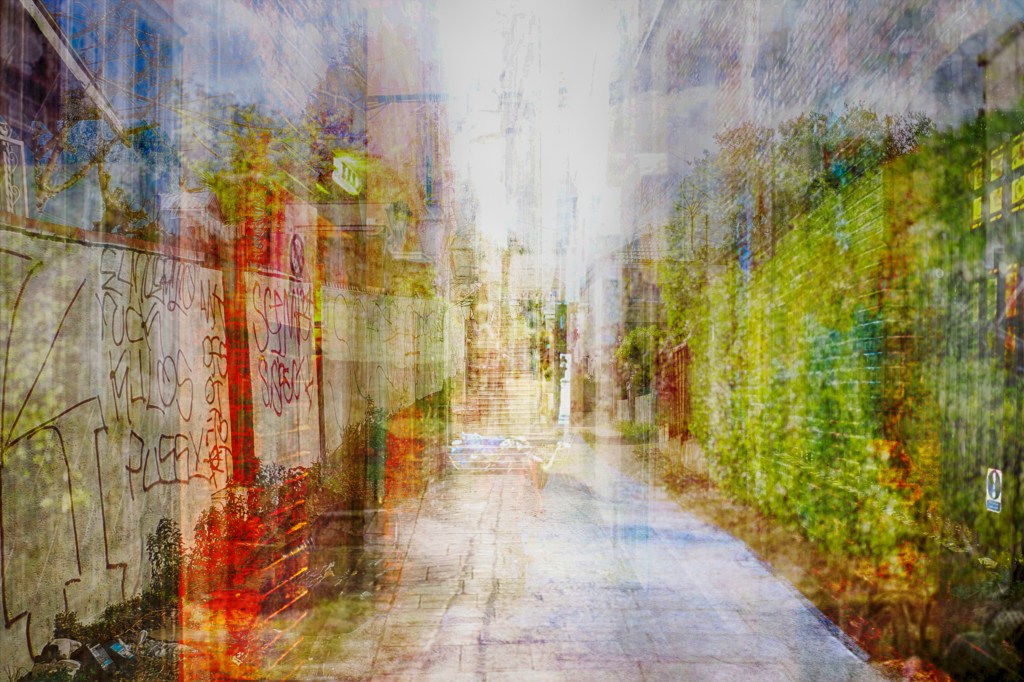
This use of public or vernacular images inspired me to look at my own project, the limitations of not being able to travel to a host of destinations and how to use appropriation/remixing to overcome this. I wanted to look at the common traits within built environments around the world. I’m often drawn towards the space between buildings and often photograph alleyways. Using this as a starting point I set out to search for images of alleyway from thirteen different countries to then combine with two images I created. I wanted to create an image that illustrates the common viewpoint different photographers use to photograph the same subject, ‘15 Alleyways’ is the end result.
 The Space Between